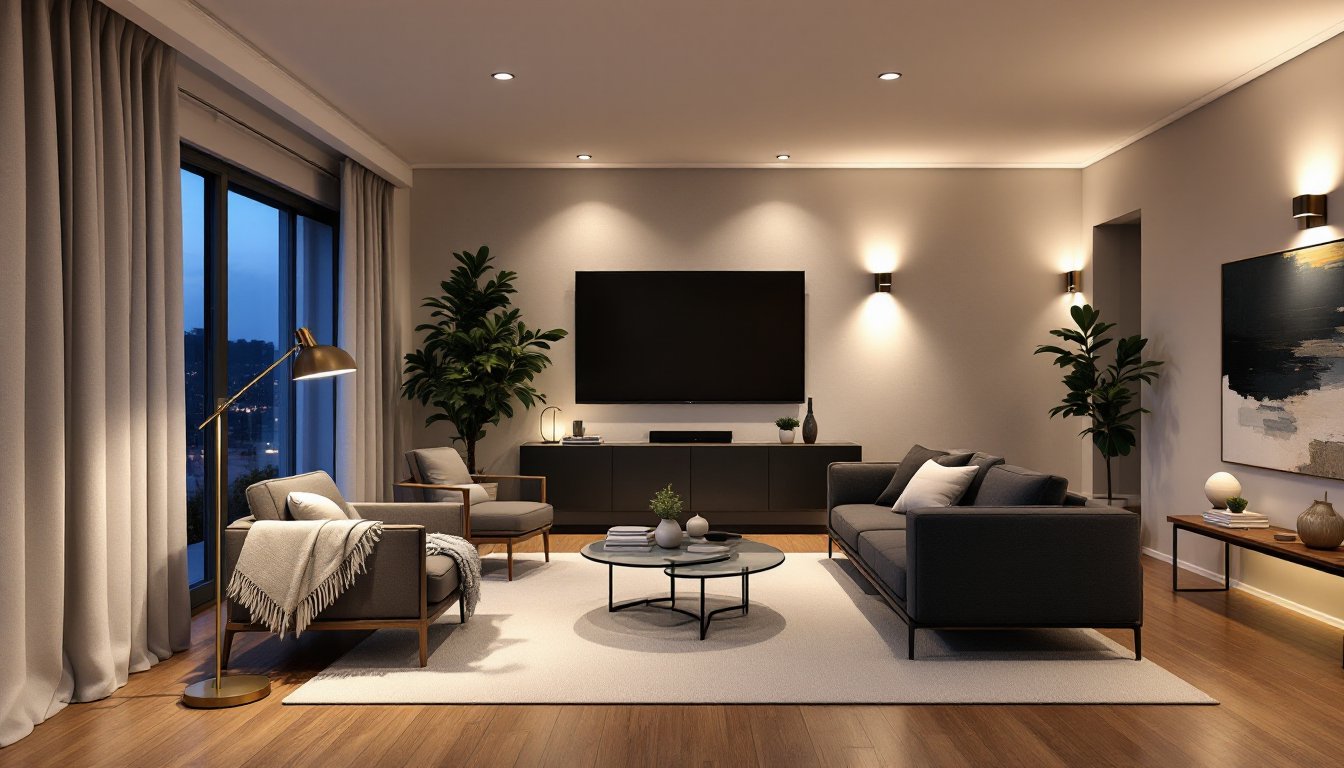
Most living rooms rely on a single overhead fixture, and it shows. Flat, uninviting light washes out details and kills any sense of warmth or depth. Mood lighting changes that equation entirely. By layering light sources at different heights, intensities, and color temperatures, homeowners can shift their living room from “functional box” to a space that actually feels like home. This isn’t about adding fairy lights and calling it a day. Proper mood lighting involves intentional placement, fixture selection, and control systems that work together to create flexible, dynamic environments suited to everything from movie nights to hosting guests.
Table of Contents
ToggleKey Takeaways
- Mood lighting living room design requires layering multiple fixture types at different heights and intensities to shift spaces from functional to warm and inviting, unlike single overhead fixtures that flatten visual interest.
- Warm color temperatures (2700K–3000K) promote relaxation and support healthy sleep patterns, while cool-toned light above 4000K signals alertness but disrupts evening melatonin production.
- Properly designed mood lighting systems can reduce residential lighting energy consumption by 30–40% compared to always-on overhead fixtures, while also improving home resale value and perceived upscale appeal.
- Effective mood lighting combines three essential layers: ambient lighting (navigable base), accent lighting (focal points and depth), and smart controls that enable dimming and scene programming for different activities.
- When selecting fixtures, prioritize dimmable LED bulbs with high CRI ratings (90+) and Matter-compatible smart switches to ensure long-term compatibility and avoid ecosystem lock-in across smart home platforms.
- Start with ambient recessed can lights spaced 4–6 feet apart, add targeted accent lights to walls and focal areas, then expand into smart controls as budget allows for maximum flexibility and comfort.
Why Mood Lighting Matters in Your Living Room
Mood lighting directly affects how people feel and function in a space. The living room serves multiple roles, reading zone, entertainment hub, conversation area, and a single lighting scheme can’t handle all of them effectively.
Biological impact matters more than most DIYers realize. Cool-toned light (4000K+) signals alertness and focus, while warm tones (2700K–3000K) promote relaxation. Harvard Medical School studies confirm that evening exposure to cooler light suppresses melatonin production, disrupting sleep patterns. A living room flooded with daylight-temperature LEDs at 8 PM works against the body’s natural wind-down process.
Spatial perception shifts with lighting placement. Wall-washing accent lights make rooms feel larger by eliminating dark corners. Low-level floor lamps add vertical dimension. Overhead-only lighting flattens everything, reducing visual interest and making furniture arrangements feel static.
Energy efficiency enters the equation when homeowners install dimmers and zone controls. Running three 9-watt LED bulbs in targeted locations beats a single 60-watt incandescent ceiling fixture for both ambiance and utility bills. The National Electrical Manufacturers Association (NEMA) reports that residential lighting accounts for roughly 15% of household electricity use, controllable mood lighting systems can cut that by 30–40% compared to always-on overhead fixtures.
Finally, resale value gets a bump. Real estate agents consistently note that homes with layered lighting and modern dimmer controls photograph better and feel more upscale during showings. It’s not structural, but it’s tangible.
Essential Types of Mood Lighting for Living Rooms
Effective mood lighting uses multiple fixture types working in layers. Each serves a distinct purpose, and skipping layers results in incomplete coverage.
Ambient Lighting: The Foundation Layer
Ambient lighting provides general illumination without harsh shadows or glare. It’s the base layer that makes a room navigable and safe.
Recessed can lights remain the most common ambient source, but placement matters. The International Residential Code (IRC) doesn’t mandate specific spacing for residential lighting, but electricians typically follow the “rule of thumb”: space recessed fixtures 4–6 feet apart for 8-foot ceilings, adjusting proportionally for higher ceilings. A 12×16-foot living room usually needs 6–8 fixtures at 10–12 watts each (LED equivalent of 60-watt incandescent).
Ceiling-mounted flush or semi-flush fixtures work when recessed cans aren’t an option (no attic access, concrete ceilings). Choose fixtures with diffusers or frosted glass to prevent direct bulb visibility, which creates glare. Multi-bulb fixtures allow for partial dimming, run two out of three bulbs for casual evening use.
Track lighting offers flexibility in rentals or spaces where homeowners want adjustable aim without rewiring. Modern low-voltage track systems use integrated LEDs with barn doors or honeycomb louvers to control spill light.
A critical detail: ambient lighting should be dimmable. A standard residential dimmer costs $15–$30 and takes 15 minutes to install (power off at the breaker first). Non-dimmable LED bulbs will flicker or fail when used with dimmers, check packaging for “dimmable” labels.
Accent Lighting: Creating Focal Points
Accent lighting adds depth, highlights architectural features, and directs attention. It typically runs at higher intensity than ambient sources within a small area.
Picture lights and wall sconces work well above artwork, built-in shelving, or fireplace mantels. Plug-in LED picture lights (battery or hardwired) have become code-compliant in most jurisdictions as long as they’re UL-listed. For hardwired sconces, boxes should be installed 60–66 inches above finished floor (AFF) for flanking a fireplace, 6–8 inches above frame tops for artwork.
Uplighting behind furniture or in corners uses floor cans or small LED puck lights to wash walls with indirect light. This eliminates the “cave effect” in rooms with dark walls or heavy furniture. Uplights should have narrow beam angles (15–25 degrees) to avoid light splatter on ceilings.
Strip lighting under floating shelves, behind TV consoles, or along toe kicks adds modern visual interest. Look for high-CRI (Color Rendering Index) LED strips, CRI above 90 renders colors accurately, while cheaper strips below 80 make everything look washed out. Most RGB color-changing strips have poor CRI in white modes: if accurate color matters, buy dedicated tunable-white strips instead.
Accent fixtures should provide three times the light level of surrounding ambient lighting to create effective contrast. Use spotlights with 10–15-degree beam spreads for tight accent work, 25–40 degrees for broader coverage.
How to Choose the Right Color Temperature and Brightness
Color temperature is measured in Kelvin (K) and dramatically affects mood. Most living rooms benefit from the 2700K–3000K range, the warm end of the spectrum.
- 2700K: Matches traditional incandescent bulbs. Warm, slightly amber. Best for evening relaxation, cozy conversations, low-key entertaining.
- 3000K: Soft white with less amber cast. Works well in transitional or modern spaces where pure warmth feels too dated.
- 3500K–4000K: Neutral to cool white. Appropriate for task reading lamps or home offices that share living room space, but harsh for general mood lighting.
Mixing color temperatures within 500K (e.g., 2700K ambient with 3000K accent) is acceptable. Wider gaps create visual discord.
Brightness is measured in lumens, not watts. LED technology decoupled the old watt-based assumptions.
- A 60-watt incandescent equivalent produces roughly 800 lumens.
- Living rooms need 10–20 lumens per square foot for ambient lighting, depending on wall colors and ceiling height. A 200-square-foot living room requires 2000–4000 total lumens from all ambient sources combined.
- Accent lights should deliver focused lumens, a 400-lumen spotlight creates sufficient contrast in most applications.
Dimmers allow users to adjust brightness by time of day. Most residential LED dimmers work down to 10% output, though cheaper bulbs may buzz or flicker below 25%. Lutron and Leviton dominate the reliable dimmer market: generic big-box dimmers work but may have narrower compatibility.
Tunable white systems (sometimes called “warm dim”) shift color temperature as brightness decreases, mimicking incandescent behavior. These cost 2–3× more than fixed-CCT bulbs but deliver noticeably better ambiance during dimmed evening use.
Smart Lighting Solutions for Dynamic Mood Control
Smart lighting platforms have matured significantly. In 2026, compatibility and feature sets justify the added cost for most homeowners tackling living room upgrades.
Smart bulbs (Philips Hue, LIFX, Wyze) screw into existing fixtures and connect via Wi-Fi or Zigbee bridges. They allow app-based dimming, color temperature adjustment, and scheduling without rewiring. Drawbacks: if someone flips the wall switch off, the bulb loses power and goes offline. Smart bulbs work best in always-on fixtures (table lamps, floor lamps) or paired with smart switches that maintain power.
Smart switches and dimmers replace standard wall switches and control any fixtures on that circuit, no special bulbs required. Brands like Lutron Caseta, Leviton Decora Smart, and GE Cync offer switches compatible with Alexa, Google Home, and Apple HomeKit. Installation requires a neutral wire in the box (mandated by NEC since 2011 but absent in older homes). A missing neutral means either running new wire or using a smart switch rated for no-neutral installations (fewer options, slightly less reliable).
Scene programming ties multiple fixtures to a single command. A “Movie Night” scene dims overhead cans to 15%, turns off wall sconces, and activates bias lighting behind the TV, all triggered by voice, app, or a programmable button. Lutron’s Pico remotes and Hue dimmer switches mount anywhere without wiring, controlling scenes via radio frequency.
Circadian lighting adjusts color temperature throughout the day, starting cool (4000K) in the morning and shifting warm (2200K) by evening. Some systems integrate with local sunrise/sunset times. This is overkill for living rooms used primarily in evenings, but it’s useful in open-plan homes where the living area serves as a daytime workspace.
Matter protocol launched fully in 2024 and now underpins cross-platform compatibility. Matter-certified devices work across Alexa, Google, and Apple ecosystems without separate bridges. When buying new smart lighting in 2026, prioritize Matter compatibility to avoid ecosystem lock-in.
One caution: cheap smart bulbs from unknown brands often lack proper certifications and have been flagged for poor dimming performance and network security vulnerabilities. Stick with UL- or ETL-listed products from established manufacturers.
Conclusion
Mood lighting transforms a living room from a one-note space into a flexible environment that adapts to how it’s actually used. Layering ambient and accent fixtures, choosing appropriate color temperatures, and integrating smart controls delivers both immediate comfort and long-term energy savings. Start with dimmable ambient sources, add targeted accent lights where they’ll have visual impact, and expand into smart systems as budget allows. The result is a room that feels intentional, not accidental.