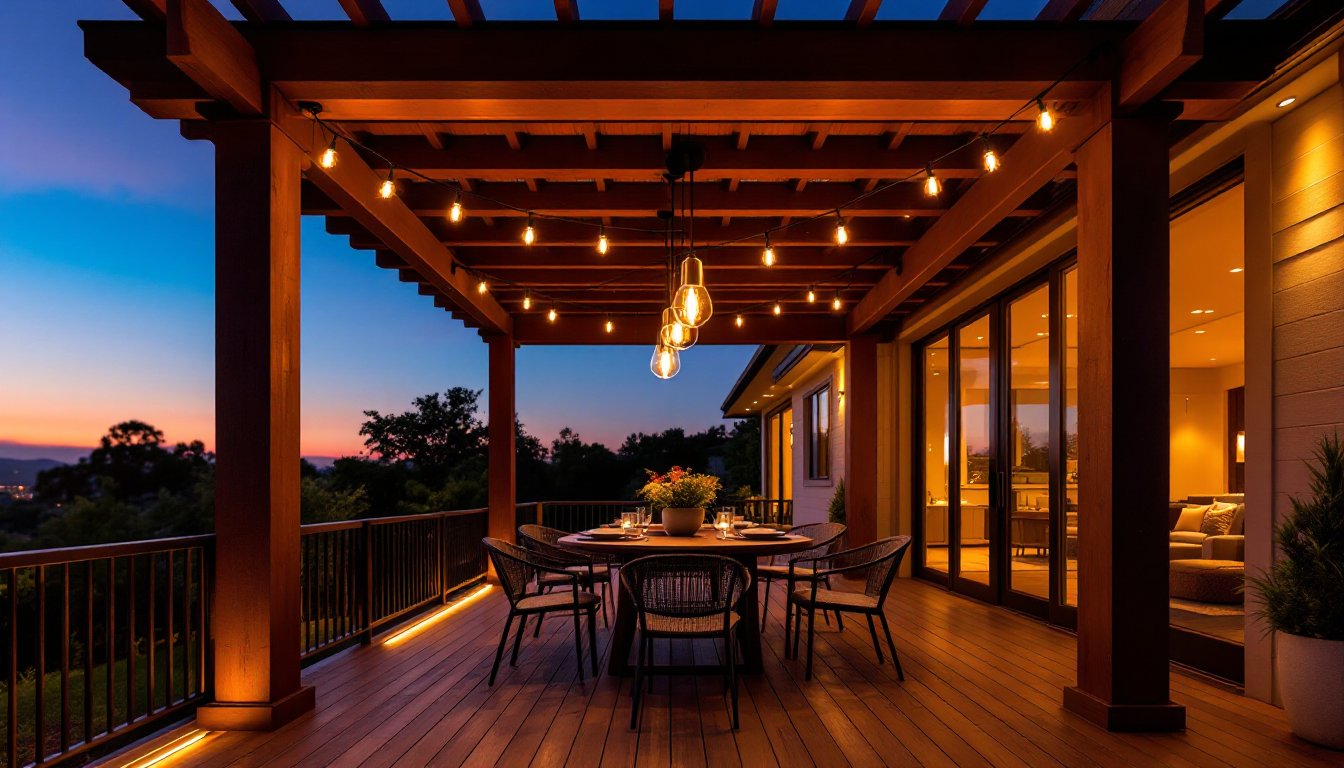
Overhead deck lighting transforms an outdoor space from a daytime-only zone into a fully functional evening retreat. Unlike step lights or rail-mounted fixtures, overhead options cast ambient light across the entire deck surface, creating usable space after sunset while adding architectural interest. The right overhead lighting setup handles everything from quiet dinners to weekend gatherings without glare or dark corners. With advances in LED efficiency, solar integration, and smart controls, today’s overhead lighting solutions offer better performance and lower operating costs than ever, but choosing the right approach depends on the deck’s structure, electrical access, and intended use.
Table of Contents
ToggleKey Takeaways
- Overhead deck lighting extends usable hours by 6–8 hours daily during warm months while improving safety by evenly illuminating surfaces and reducing trip hazards.
- String lights with tensioned cable systems or pole-mounted setups offer accessible overhead lighting options, with LED bulbs providing 15,000+ hours of runtime at just 5–7 watts per bulb compared to energy-hungry incandescent alternatives.
- Pergolas and gazebos provide ideal frameworks for built-in overhead lighting through recessed LED canisters spaced 4–6 feet apart or wet-rated flush-mount fixtures rated for direct rain exposure.
- LED strip lights and modern track lighting deliver sleek, energy-efficient illumination for contemporary decks, but must be IP67/IP68-rated for outdoor weatherproofing and paired with appropriately sized power supplies.
- Solar-powered overhead deck lighting eliminates electrical runs for areas receiving 6+ hours of daily sunlight, though brightness tops out at 200–400 lumens—suitable for ambiance but not task lighting.
- Always verify local building codes for outdoor circuit permits and use GFCI-protected, weatherproof components; choose 12-gauge wiring for electrical runs longer than 50 feet to prevent voltage drop.
Why Overhead Deck Lighting Is a Game-Changer for Outdoor Living
Overhead lighting extends usable hours on a deck by six to eight hours daily during warmer months. It eliminates the need for portable lamps or candles, which tip over in wind and provide inconsistent coverage.
From a safety standpoint, overhead fixtures reduce trip hazards by evenly illuminating the deck surface, stairs, and transitions to other areas. They also deter unwanted visitors, both wildlife and human, by eliminating dark zones around entry points.
Structurally, overhead lighting works best on decks with existing coverage (pergolas, gazebos, or roof extensions) or where posts and beams can support fixture weight and conduit runs. Freestanding decks without overhead structures require either standalone poles, tensioned cable systems between posts, or creative use of nearby trees or fence lines.
Electrical considerations: Most overhead lighting requires a GFCI-protected circuit rated for outdoor use. If the deck is more than 20 feet from the house, voltage drop becomes a factor, 14-gauge wire is standard for runs under 50 feet at 15 amps, but longer distances may need 12-gauge. Solar and battery-powered options sidestep electrical runs entirely but come with brightness and runtime trade-offs. Always check local codes: some jurisdictions require permits for new outdoor circuits or fixtures mounted above a certain height.
String Lights and Bistro Bulbs: Classic Ambiance Made Easy
String lights remain the most accessible overhead lighting option. They require minimal tools, no hardwiring in many cases, and adapt to nearly any deck layout. Edison-style bistro bulbs (typically E26 or E12 base) provide warm, diffused light ideal for social spaces, while smaller fairy lights work better as accent layers.
Installation methods:
- Tensioned cable runs: Use galvanized aircraft cable (1/8-inch diameter) with turnbuckles for spans up to 25 feet. Attach to eye bolts screwed into structural posts or fascia boards, never just into deck boards or rail caps.
- Pole-mounted setups: For decks without overhead structure, 4×4 posts sunk 24 inches into concrete footings with post-to-beam brackets provide anchor points. Space poles 15 to 20 feet apart to avoid excessive cable sag.
- Tree or fence integration: Stainless steel eye hooks into healthy hardwood trees (avoid soft species like birch) or fence posts can work, but check for movement over time.
Weatherproofing: Use IP65-rated string lights for rain and dust resistance. Plug into a GFCI outlet or a weatherproof outdoor timer. For permanent installs, consider hardwiring into a junction box with a dimmer switch.
Bulb choice matters: Incandescent bulbs create warmth but pull 40–60 watts per bulb and burn out in 1,000 hours. LED equivalents use 5–7 watts, last 15,000+ hours, and stay cooler, critical when strands run near fabric awnings or wood. Shatterproof bulbs (acrylic or silicone-coated) prevent glass shards on the deck surface if one breaks.
Pergola and Gazebo Integrated Lighting Solutions
Pergolas and gazebos provide the ideal framework for built-in overhead lighting. Recessed canister lights fit between rafters or slats, while flush-mount or semi-flush fixtures attach directly to crossbeams.
Recessed options: Low-profile LED canisters (4- to 6-inch diameter) install between 2×6 or 2×8 rafters. Look for IC-rated (insulation contact) housings even outdoors, they dissipate heat better and meet code in most areas. Space fixtures 4 to 6 feet apart for even coverage. Retrofit kits with spring clips simplify installation in existing structures without cutting large holes.
Flush and semi-flush mounts: These attach to the underside of beams or a solid gazebo roof. Choose fixtures rated for wet or damp locations depending on exposure. Wet-rated fixtures handle direct rain: damp-rated work under cover but not in direct spray. A common mistake: using indoor-rated flush mounts under a pergola with open slats, they’ll corrode within a season.
Wiring through structure: Run UF-B (underground feeder) cable through drilled holes in posts and beams, secured with cable staples every 24 inches. If surface-mounting conduit, use PVC-coated or galvanized rigid conduit to prevent rust. Junction boxes should be weatherproof (NEMA 3R minimum) and accessible for future bulb changes.
Lighting control: Install a dimmer compatible with LED fixtures (not all dimmers work with low-wattage LEDs). Three-way switches at both house and deck entries add convenience.
Modern LED Strips and Track Lighting for Contemporary Decks
LED strip lights (also called tape lights) deliver sleek, continuous illumination along pergola beams, under railings, or within soffits. They’re low-profile, energy-efficient, and available in tunable color temperatures from warm white (2700K) to daylight (5000K).
Installation basics:
- Strip selection: Choose IP67 or IP68-rated strips for direct weather exposure (silicone coating protects LEDs). Standard IP20 indoor strips fail quickly outdoors.
- Mounting: Adhesive backing works on clean, dry surfaces, but aluminum channels improve heat dissipation and protect the strip. Channels also diffuse light, reducing the dotted LED look.
- Power supply: LED strips run on 12V or 24V DC. The power supply (transformer) must be rated for total wattage plus 20% headroom. A 16-foot strip at 4.4 watts per foot needs a 100-watt supply minimum. Mount transformers in a weatherproof enclosure or inside the house near the outdoor outlet.
Track lighting suits decks with solid overhead covers (roof extensions or pergola tops with closed slats). Surface-mounted or recessed tracks let users adjust fixture positions. Use wet-location track heads and ensure the track itself is rated for outdoor use, indoor track corrodes and fails safety inspections.
Color and control: RGBW (red, green, blue, white) LED strips pair with smartphone controllers for customizable scenes, but white-only strips often provide better light quality for tasks like grilling or dining. Avoid the temptation to over-light, too much brightness destroys ambiance and creates glare.
Statement Chandeliers and Pendant Lights for Covered Decks
Outdoor-rated chandeliers and pendants turn covered decks into open-air dining rooms or lounges. They require solid overhead structure and weatherproof electrical boxes but deliver both function and focal-point design.
Structural requirements: A chandelier weighing 30+ pounds needs a ceiling-rated electrical box secured to a joist or beam, not just drywall anchors. If the existing junction box isn’t rated for fixture weight, replace it with a fan-rated pancake box or a box with an adjustable bar hanger. For pergolas, through-bolt the box into a 2×6 or larger beam.
Choosing the right fixture:
- Wet vs. damp rating: Fully exposed locations need wet-rated fixtures. Covered porches or gazebos with solid roofs can use damp-rated options.
- Material durability: Stainless steel, powder-coated aluminum, and marine-grade brass resist corrosion. Avoid uncoated iron or untreated wood components, they rust or warp.
- Bulb access: Fixtures with easily removable shades or cages simplify bulb changes. Sealed units with integrated LEDs last 20+ years but require full fixture replacement when they fail.
Pendant spacing: For a dining table, hang pendants 30 to 36 inches above the surface. Over a conversation area, 7 feet minimum clearance prevents head strikes. Use adjustable-height downrods to fine-tune positioning.
Dimming and ambiance: Install a low-voltage dimmer compatible with the fixture’s LED driver. Not all outdoor fixtures are dimmable, check specs before buying.
Smart and Solar-Powered Overhead Lighting Options
Smart lighting integrates with home automation systems, enabling voice control, scheduling, and remote access via smartphone apps. Most smart outdoor fixtures use Wi-Fi or Zigbee protocols. Wi-Fi fixtures connect directly to a home network: Zigbee requires a hub (like Philips Hue Bridge or SmartThings).
Smart bulbs vs. smart fixtures: Retrofitting existing fixtures with smart bulbs (E26 base) is cheaper upfront but means the wall switch must stay on, turning it off kills the bulb’s connectivity. Dedicated smart fixtures integrate controls and often include motion sensors or color-changing LEDs.
Solar-powered overhead lighting eliminates electrical runs but demands realistic expectations. Solar string lights and solar pendants work in areas with 6+ hours of direct sunlight daily. Shaded decks or northern exposures won’t charge panels sufficiently.
Performance factors:
- Battery capacity: Lithium-ion batteries outperform NiMH in cold weather and hold charge longer. Look for 2000mAh minimum for all-night runtime.
- Panel size and efficiency: Larger panels (6×6 inches or bigger) charge faster. Monocrystalline panels are more efficient than polycrystalline.
- Brightness: Most solar fixtures top out at 200–400 lumens total, enough for ambiance, not task lighting. Hardwired LEDs easily deliver 800+ lumens per fixture.
Installation tip: Mount solar panels where they’ll get maximum sun, even if that means separating them from the fixture using extension cables (many systems allow 10- to 15-foot distances).
Conclusion
Overhead deck lighting blends function and atmosphere, turning underused outdoor space into a nighttime destination. Whether it’s the approachable warmth of bistro bulbs, the precision of recessed LEDs, or the convenience of solar and smart controls, the best setup matches the deck’s structure, electrical access, and how the space gets used. Focus on weatherproof components, proper mounting, and code-compliant wiring, then enjoy the extended evenings.