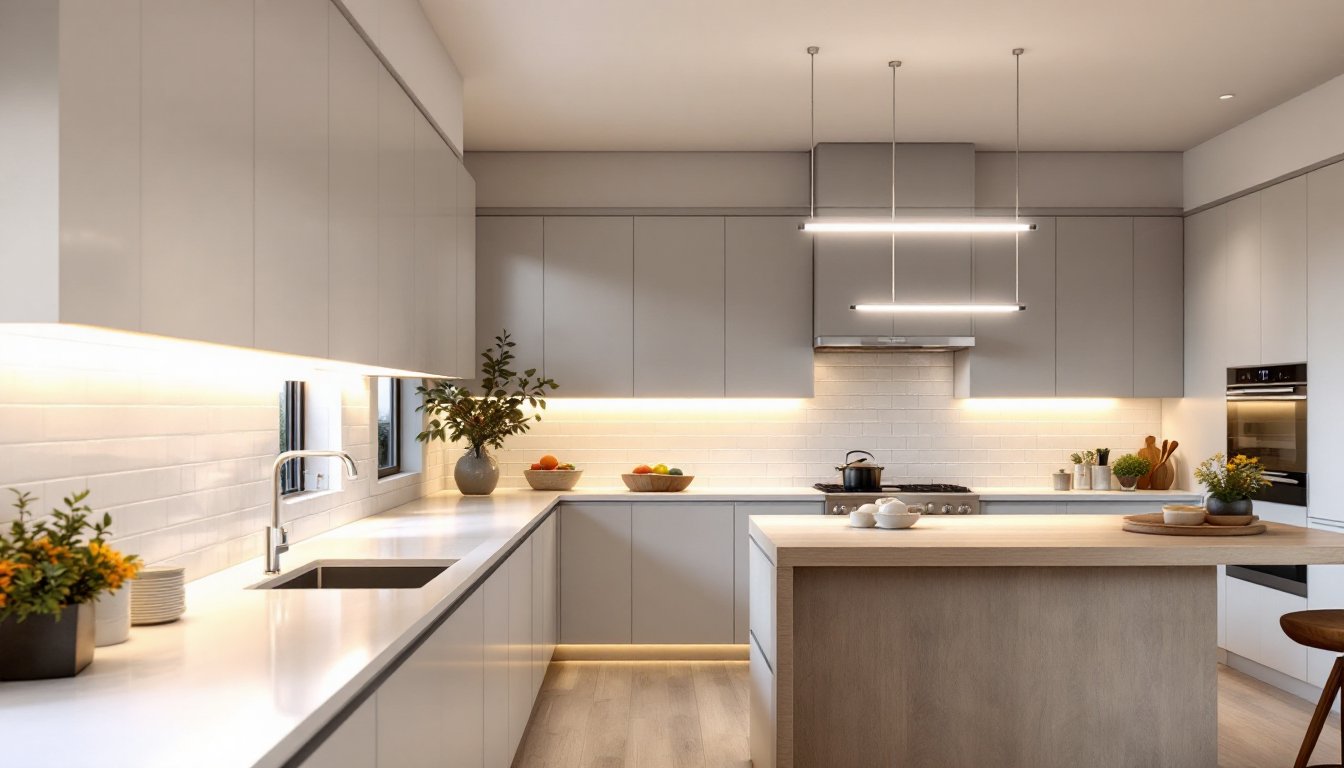
Linear kitchen lighting transforms cluttered, shadowy workspaces into bright, functional zones with clean lines and even coverage. Unlike traditional pendant clusters or flush-mount fixtures, linear lights distribute illumination across a wider area, reducing harsh shadows and creating a streamlined aesthetic that works in both contemporary and transitional kitchens. From under-cabinet strips that banish countertop shadows to oversized island pendants that double as design statements, linear fixtures offer versatility, efficiency, and a professional look. This guide covers the types, placement, and selection criteria that help homeowners and DIYers get the most from linear lighting installations.
Table of Contents
ToggleKey Takeaways
- Linear kitchen lighting eliminates shadows and creates even task illumination across countertops and islands, offering superior coverage compared to traditional point-source fixtures like recessed cans.
- LED-based linear fixtures consume 75–90% less energy than incandescent alternatives and last 25,000–50,000 hours, delivering measurable savings on utility bills and HVAC load.
- Under-cabinet, suspended pendant, and cove linear lighting systems accommodate different kitchen zones—task prep areas, islands, and ambient design elements—each with specific mounting and spacing requirements.
- High-quality linear kitchen lighting selections require attention to lumens (300–500 per linear foot for task zones), color temperature (3000K as the ideal balance), and CRI ≥90 for accurate food and color rendering.
- Hardwired linear fixtures require professional electrical work, while plug-in under-cabinet options install in minutes with adhesive mounts, making them ideal for renters or quick kitchen upgrades.
What Is Linear Kitchen Lighting?
Linear kitchen lighting refers to any elongated fixture, typically in a bar, strip, or rail configuration, that distributes light along a continuous axis rather than from a single point. Common examples include LED strip lights, LED light bars, track lighting, and suspended linear pendants.
The defining feature is the light source’s length-to-width ratio. Where a standard recessed can might be 6″ in diameter, a linear fixture could span 24″, 48″, or even 72″ while remaining only 2–4″ wide. This geometry makes linear lighting ideal for task zones, islands, and peninsulas where even coverage matters more than concentrated brightness.
Most modern linear fixtures use LED technology for efficiency, low heat output, and long service life, often 25,000 to 50,000 hours. They’re available in hardwired and plug-in versions, with dimming capability, color-temperature adjustment (warm white to daylight), and smart-home integration becoming standard features in mid-range and premium models.
Linear lighting isn’t new, fluorescent strips dominated workshop and commercial spaces for decades, but contemporary LEDs deliver better color rendering (CRI ≥90), instant-on performance, and sleeker profiles without the flicker or hum of older ballast-driven systems.
Benefits of Linear Lighting in Kitchen Design
Even Task Illumination: Linear fixtures eliminate the hot spots and dark zones created by point-source lighting. A 36″ LED bar mounted under wall cabinets lights the entire countertop prep area uniformly, making chopping, reading recipes, and inspecting food easier and safer.
Visual Continuity: The unbroken line of light reinforces clean, horizontal design elements, ideal for modern, minimalist, or Scandinavian-inspired kitchens. Linear fixtures complement flat-panel cabinetry, quartz countertops, and stainless appliances without visual clutter.
Scalability: A single fixture can cover the span that would require multiple recessed cans or puck lights, reducing installation complexity and energy draw. For a 10-foot island, one 60″ pendant replaces three or four individual pendants, cutting electrical rough-in and simplifying dimmer control.
Energy Efficiency: LED linear fixtures consume 4–12 watts per foot compared to 40–75 watts for equivalent incandescent or halogen sources. Over a 50,000-hour lifespan, that translates to measurable savings on utility bills and reduced HVAC load from lower heat output.
Dimming & Color Control: Many linear LEDs offer seamless 0–100% dimming and tunable white (2700K to 5000K) or full RGB color changing. This flexibility supports different activities, bright daylight for meal prep, warm ambient light for dinner, or colored accents for entertaining, without switching fixtures or adding complex control systems.
Types of Linear Kitchen Light Fixtures
Under-Cabinet Linear Lights
These mount to the underside of wall cabinets, aiming downward to illuminate countertops. They’re the workhorse of kitchen task lighting and come in three main formats:
- LED strip lights (tape lights): Flexible adhesive-backed strips, typically 12V or 24V DC, available in 16.4-foot reels. Cut to length at marked intervals (every 2–4″). Best for concealed installations inside cabinet toe kicks, cove details, or under shallow shelves. Look for IP ratings (IP65 or higher) in splash-prone zones.
- LED light bars (hard strips): Rigid aluminum channels with integrated LEDs, ranging from 12″ to 48″. Easier to mount than tape lights, with cleaner light output and better heat dissipation. Many include diffusers to soften hotspots. Hardwired or plug-in versions available.
- Puck lights in linear arrays: Individual hockey-puck–sized fixtures linked in series. Less common now, but still useful for cabinets with odd spacing or obstacles like range hoods.
Installation Note: Under-cabinet lights work best when mounted toward the front edge of the cabinet base (not the back wall) to minimize shadows cast by the user’s body. Use a level and mark stud locations or cabinet frame members if screwing into wood: adhesive mounts work on smooth surfaces but may sag over time under heat or vibration.
Safety: If hardwiring, turn off the circuit breaker and confirm with a non-contact voltage tester. Low-voltage (12V/24V) systems require a driver or transformer: follow NEC Article 411 for installation requirements.
Pendant and Island Linear Fixtures
Suspended from the ceiling by cables, rods, or chains, these serve as both task and ambient lighting over islands, peninsulas, or dining zones. Typical lengths range from 30″ to 72″, with single or multiple rows of LEDs.
- Single-bar pendants: One continuous light source in a slim profile (1–3″ diameter). Works well over narrow islands (30–42″ wide) or in galley kitchens. Mount 30–36″ above the countertop for clearance.
- Multi-bar or ladder-style pendants: Two or more parallel tubes or rods in a frame. Adds visual mass and more light output for larger islands (48″ or wider). Adjustable suspension length accommodates varying ceiling heights.
- Track-based linear systems: Modular rails with movable heads or LED strips. Allows repositioning as layout needs change. Good for open-plan kitchens where lighting zones shift.
Sizing Rule of Thumb: For islands, allow roughly two-thirds to three-quarters the island’s length. A 72″ island pairs well with a 48–54″ pendant. For multiple fixtures, space them evenly and maintain at least 30″ clear sightlines over seated areas.
Installation: Most hardwired pendants require a standard ceiling junction box rated for the fixture’s weight (check manufacturer specs, some linear fixtures exceed 10 lbs). If the existing box is off-center, use an adjustable ceiling canopy or install a new box anchored to a ceiling joist or blocking. If you’re not comfortable working with 120V wiring or cutting into drywall, hire a licensed electrician.
Where to Install Linear Lighting in Your Kitchen
Under Wall Cabinets: The most common application. Provides direct task lighting for food prep, washing, and appliance work. Install along the full run of cabinetry for uniform coverage, or target specific zones (sink, range, primary prep area) if budget or wiring limits scope.
Inside Glass-Front or Open Cabinets: Illuminates dishes, glassware, or decorative items. Use warm white (2700–3000K) LEDs to avoid a cold, clinical look. Keep brightness moderate, accent lighting shouldn’t compete with task zones.
Toe Kick or Cabinet Base: Recessed strips at floor level create a floating effect and provide subtle night lighting. Useful in kitchens with minimal upper cabinetry or for aging-in-place designs where nighttime navigation is a priority.
Over Islands and Peninsulas: Suspended linear pendants provide both downlight (for task work) and ambient fill. Center the fixture(s) over the countertop, not the seating side, to avoid glare in diners’ eyes. Use dimmers to adjust intensity for cooking versus entertaining.
Along Soffits or Cove Ceilings: Indirect linear lighting washes the ceiling plane, raising perceived ceiling height and softening overall ambiance. Best for kitchens with 9-foot or higher ceilings: skip this in 8-foot spaces where the effect is less dramatic.
Shelf or Floating Shelf Edges: Concealed strip lighting under or behind open shelving highlights cookbooks, plants, or ceramics. Route wiring through shelf standards or use plug-in strips with cord management.
Choosing the Right Linear Lighting for Your Space
Lumens & Coverage: For task lighting, target 300–500 lumens per linear foot of countertop. A 4-foot countertop run needs roughly 1,200–2,000 lumens total. Under-cabinet bars typically output 200–400 lumens per foot: check product specs and calculate the total run.
Color Temperature (Kelvin): Warm white (2700–3000K) mimics incandescent bulbs and suits traditional or transitional kitchens. Neutral white (3500–4000K) offers balanced color rendering for contemporary spaces. Daylight (5000K+) is stark and best reserved for workshops or commercial kitchens. Many prefer 3000K as the sweet spot, warm enough to feel inviting, bright enough for accurate color perception.
CRI (Color Rendering Index): Choose fixtures with CRI ≥90 for kitchens. Lower-CRI LEDs make reds and greens look muddy, affecting everything from produce selection to paint-color decisions. High-CRI lighting costs slightly more but pays off in visual comfort.
Dimming Compatibility: Verify that the fixture, driver, and wall dimmer are compatible. LED dimming issues (flickering, dead travel, humming) usually stem from mismatched components. Look for fixtures explicitly labeled “0–10V dimmable,” “TRIAC dimmable,” or “ELV/MLV compatible.” If retrofitting an existing dimmer, confirm it’s LED-rated: older incandescent dimmers often can’t regulate the low wattage of LED loads.
Mounting & Installation Complexity: Plug-in under-cabinet lights install in minutes with adhesive clips or screws and a nearby outlet, ideal for renters or quick upgrades. Hardwired systems require cutting in boxes, running cable (often 14/2 or 12/2 NM-B depending on circuit load), and making connections, best handled during a remodel or by someone comfortable with basic electrical work.
Wet or Damp Ratings: For areas near sinks, dishwashers, or ranges, use fixtures rated for damp locations at minimum. Fully enclosed or gasketed fixtures handle splashes better than open-channel designs.
Smart Features: Wi-Fi or Zigbee–enabled linear lights integrate with voice assistants, timers, and home-automation routines. Useful but not essential: evaluate whether the added cost (and potential firmware headaches) aligns with how the homeowner actually uses lighting controls.
Budget & Quality: Entry-level LED strips start around $15–25 for 16 feet: premium hardwired bars run $80–200 per 4-foot section. Island pendants range from $150 for basic aluminum extrusions to $800+ for designer finishes. Prioritize UL or ETL listing, robust driver warranties (at least 3 years), and access to replacement parts. Cheap no-name imports may save upfront but often fail early or lack proper certifications.