The kitchen table has evolved from a purely functional surface into a centerpiece for gathering, working, and entertaining, and lighting designers have taken notice. In 2026, fixture trends reflect a shift toward bold artistic expression, human-centric design, and tech integration that actually solves problems. Gone are the generic drum pendants and cookie-cutter chandeliers. Today’s homeowners are installing statement pieces that balance visual drama with practical illumination. Whether someone’s updating a century-old farmhouse or a new-construction open concept, understanding current trends helps narrow choices and avoid fixtures that’ll look dated in three years.
Table of Contents
ToggleKey Takeaways
- Kitchen table lighting trends in 2026 prioritize bold statement fixtures that combine artistic expression with practical illumination, replacing generic designs with conversation-starting pieces.
- Sculptural and warm minimal fixtures work best when properly proportioned to the table—use one-half to two-thirds of table width for fixture diameter and hang fixtures 30 to 36 inches above the table surface.
- Layered lighting combining ambient, task, and accent sources on separate switches provides flexibility throughout the day and requires careful circuit planning and professional installation for safety.
- Smart tunable white bulbs and dimmers offer circadian-friendly benefits by shifting color temperatures from cooler morning light to warmer evening tones, though installation requires neutral wires at switch locations.
- Choose the right kitchen table lighting by measuring your space first, targeting 30 to 40 lumens per square foot, selecting LED bulbs with CRI 90+, and verifying dimmer compatibility before purchase.
Sculptural Statement Fixtures That Command Attention
Large-scale, art-forward fixtures are dominating kitchen and dining spaces in 2026. These aren’t subtle accents, they’re conversation starters that double as functional sculpture.
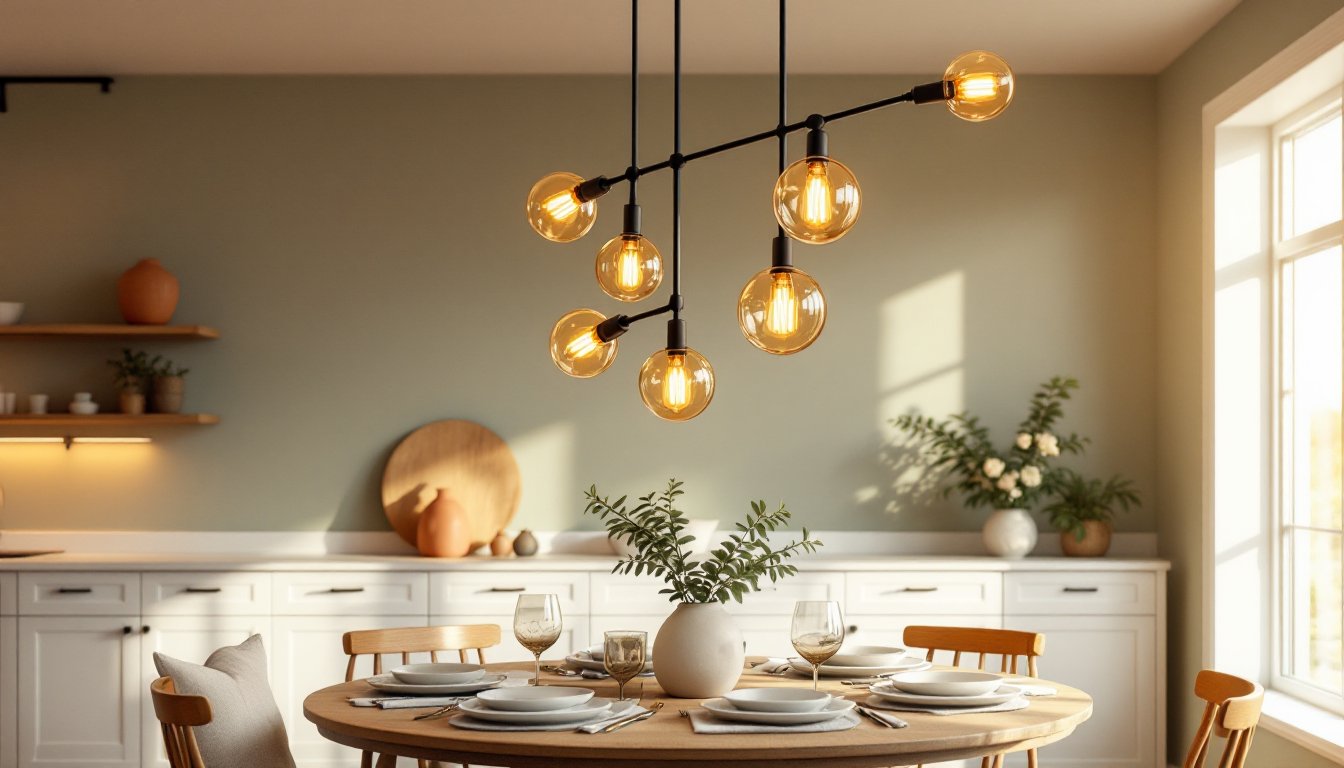
Asymmetrical chandeliers with arms extending at unexpected angles create visual movement. Many feature mixed-height bulb placement that breaks the traditional symmetry of classic chandeliers. Installation requires careful attention to the ceiling junction box rating: fixtures weighing over 50 pounds need additional bracing anchored to framing, not just drywall or plaster.
Oversized globe pendants, 18 to 24 inches in diameter, work especially well over round or oval tables. The key is proportion: the fixture diameter should be roughly one-half to two-thirds the table width. A 36-inch round table pairs well with a 20-inch pendant, while a 72-inch rectangular table can handle a linear arrangement of three 16-inch globes spaced evenly.
These statement pieces often incorporate hand-blown glass, natural rattan, or blackened steel frameworks. The artisan quality means higher price points, expect $400 to $1,800 for designer fixtures, but the visual impact justifies the investment for homeowners prioritizing distinctive style.
One practical note: verify the fixture’s adjustable hanging length before purchasing. Standard ceilings (8 feet) require different cord or chain lengths than vaulted or 10-foot ceilings. The bottom of the fixture should hang 30 to 36 inches above the table surface to avoid head-knocking while maintaining effective illumination.
Warm Minimalism: The Rise of Soft, Organic Shapes
As a counter-movement to sharp industrial styles, 2026 brings a wave of fixtures emphasizing rounded edges, matte finishes, and natural materials. This isn’t sterile Scandinavian minimalism, it’s warm, tactile, and approachable.
Paper and linen drum shades are reappearing, but with improved construction. Modern versions use flame-retardant materials rated for direct bulb contact and feature reinforced wire frames that resist sagging. These diffuse light beautifully, eliminating harsh shadows during meals.
Ceramic and stoneware pendants in cream, terracotta, and soft sage provide texture without visual clutter. Many are handmade with slight variations between pieces, adding character. The weight considerations matter here, ceramic fixtures often exceed 15 pounds, requiring a ceiling box rated for the load and possibly a hickey or reducing strap to adapt older electrical boxes.
Wood elements are showing up in unexpected ways: turned oak pendants, walnut veneer drum shades, and bamboo cage fixtures. When using wood fixtures over dining areas, ensure they’re sealed or finished to handle occasional humidity from nearby cooking. Unsealed wood can warp or develop mildew in high-moisture environments.
The color temperatures leaning toward this aesthetic favor 2700K to 3000K bulbs, warm white that complements natural materials and makes food look appetizing. Cooler temps (4000K+) create an institutional feel that clashes with organic design intent.
Layered Lighting for Ultimate Flexibility
Single-source lighting is losing ground to multi-layer approaches that combine ambient, task, and accent lighting for adaptability throughout the day.
The typical setup includes a primary fixture (pendant or chandelier) over the table, supplemented by recessed cans or track lighting on separate switches. Recessed lights should be positioned 24 to 30 inches from walls and spaced roughly 4 to 6 feet apart depending on ceiling height and beam spread. For an 8-foot ceiling, 4-inch aperture cans with 40-degree beam angles provide good coverage without hot spots.
Under-cabinet LED strips or puck lights contribute task lighting for food prep while adding a soft glow during evening meals. Installing these on dimmer-compatible drivers prevents the harsh, fully-lit look when ambiance matters more than visibility.
Wall sconces flanking a built-in banquette or buffet add vertical illumination and architectural interest. Mount them 60 to 66 inches from the floor to avoid glare at eye level when seated. Battery-powered options exist, but hardwired installations provide reliable, long-term performance without the hassle of recharging or replacing batteries.
The wiring implications deserve attention. Adding multiple lighting layers often means running new circuits or installing multi-gang switch boxes. If the existing electrical panel lacks capacity, this may require a subpanel or service upgrade, work that requires a licensed electrician and permits in most jurisdictions.
Smart Lighting Integration and Color Temperature Control
Smart bulbs and fixtures have moved beyond novelty into genuinely useful territory for kitchen table lighting. The 2026 trend focuses on circadian-friendly tunable white systems rather than gimmicky color-changing modes.
Tunable white LEDs shift color temperature throughout the day, cooler (4000K) during morning breakfast for alertness, warmer (2200K) during dinner for relaxation. Quality systems allow scheduling via app or voice control through Zigbee, Z-Wave, or Wi-Fi protocols. Zigbee and Z-Wave require a hub (like SmartThings or Hubitat) but offer better reliability and don’t congest home Wi-Fi networks.
Installing smart switches versus smart bulbs depends on the fixture. Chandeliers with multiple candelabra-base bulbs become expensive to outfit with individual smart bulbs at $12 to $18 each. A smart dimmer switch (like Lutron Caseta or Leviton Decora Smart) controls the entire fixture from one point and typically costs $50 to $80.
One wiring caution: most smart switches require a neutral wire at the switch box. Homes built before the 1980s often lack neutrals in switch boxes, necessitating either running new wire or choosing the fewer smart switches designed for no-neutral installations (which have limited dimming range).
Occupancy sensors integrated into smart ecosystems can auto-dim or turn off lights when the table area is vacant for a set period, cutting energy waste. Avoid mounting motion sensors directly above the table, they perform better positioned at entry points to the room.
Mixed Metals and Textured Finishes Making a Comeback
The matchy-matchy hardware era is over. Deliberately mixed metal finishes create visual depth and allow homeowners to layer in new pieces without replacing everything.
Popular combinations pair brushed brass or champagne bronze with matte black accents. A linear chandelier might feature a black metal frame with brass socket covers and canopy. This plays well in transitional spaces where cabinet hardware, faucets, and light fixtures can span a complementary range rather than identical finishes.
Textured powder coats, think hammered, speckled, or sandblasted surfaces, are replacing glossy lacquers. These finishes hide fingerprints and minor dings better than polished metals, practical in high-traffic areas where hands frequently adjust fixture height or swap bulbs.
Antique and oil-rubbed finishes that show intentional patina appeal to farmhouse and industrial aesthetics. These aren’t low-maintenance, though. They can wear unevenly if cleaned with abrasive products. A soft cloth and mild soap preserve the finish better than all-purpose sprays containing ammonia or bleach.
When mixing metals, stick to warm with warm, cool with cool to maintain cohesion. Brushed nickel (cool) and matte black (neutral) combine well. Brass (warm) and copper (warm) pair naturally. Crossing those lines, polished chrome with oil-rubbed bronze, usually looks accidental rather than intentional.
Be aware that metal finishes affect perceived fixture size. Dark metals recede visually, making bold fixtures feel less imposing. Polished metals reflect light and appear larger, which can overwhelm smaller dining areas.
How to Choose the Right Kitchen Table Lighting for Your Space
Trends inform choices, but practical fit determines success. Start with measurements, not aesthetics.
Fixture size: Add the room’s length and width in feet. That sum in inches gives a proportional chandelier diameter. A 12×14-foot dining area suggests a 26-inch fixture. For rectangular tables, linear fixtures should span half to two-thirds the table length.
Mounting height: Measure from the table surface, not the floor. The standard 30 to 36 inches works for most situations. Lower (28 inches) suits intimate settings: higher (38 to 40 inches) prevents head clearance issues in high-traffic zones or with taller diners.
Light output: Target 30 to 40 lumens per square foot for dining areas. A 120-square-foot space needs roughly 3,600 to 4,800 lumens total. A three-bulb chandelier using 1,200-lumen LED bulbs delivers 3,600 lumens, adequate for ambient lighting but may need supplemental sources for task work.
Bulb type and CRI: Use LED bulbs with a CRI (Color Rendering Index) of 90 or higher to render food colors accurately. Cheap LEDs with CRI below 80 make meals look unappetizing.
Dimming compatibility: Verify the fixture supports dimming if that’s desired. Not all LED drivers dim smoothly: some flicker or won’t go below 20% brightness. Look for fixtures explicitly listing dimmer compatibility.
Installation complexity: Swapping a like-for-like fixture is straightforward DIY if comfortable with electrical work. Adding new junction boxes, relocating ceiling boxes, or installing heavy fixtures (50+ pounds) may require a pro. Most jurisdictions allow homeowners to do their own electrical work but require permits and inspections for safety.
Conclusion
Kitchen table lighting in 2026 rewards intentionality. The standout installations blend artistic boldness with layered functionality and smart tech that enhances daily routines without adding complexity. Homeowners willing to measure carefully, think beyond a single fixture, and invest in quality materials will create spaces that work as well as they look. Trends shift, but good design fundamentals, proper scale, adequate light output, and thoughtful integration, never go out of style.