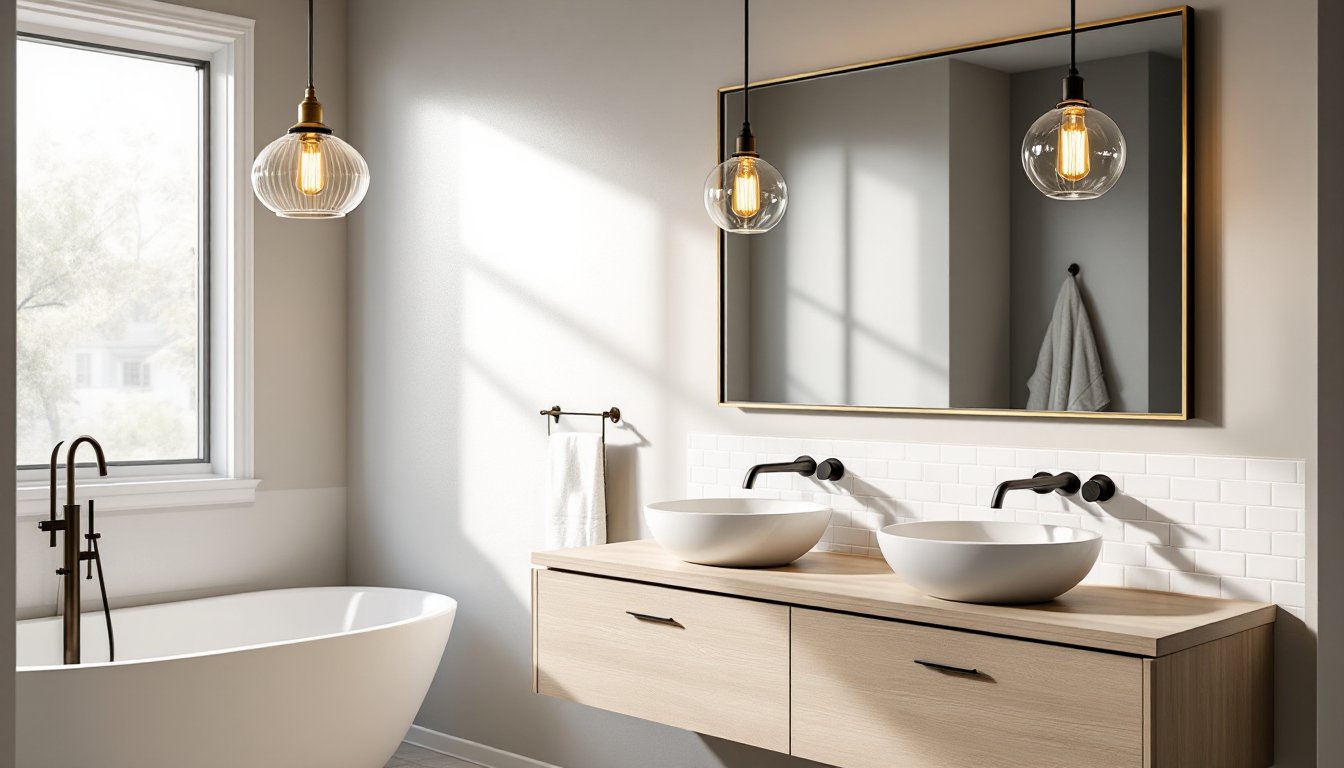
Pendant lighting has moved beyond kitchens and dining rooms, it’s now a go-to choice for bathrooms that need both task lighting and visual interest. Unlike standard vanity bars or recessed cans, pendants add vertical dimension and can be positioned exactly where light is needed most. They work especially well in bathrooms with high ceilings or where a design focal point is lacking. But installing pendant lights in a bathroom isn’t as simple as screwing in a bulb. Moisture, electrical codes, and fixture placement all matter. This guide covers where to hang them, how to pick the right size and style, and what safety requirements apply.
Table of Contents
ToggleKey Takeaways
- Pendant lighting for bathrooms offers practical task lighting and design appeal by hanging vertically to fill empty ceiling space, unlike recessed fixtures that require cutting into the structure.
- Proper placement matters: hang pendants 30 to 40 inches above vanity countertops, centered over sinks and spaced 30 to 36 inches apart for double-sink vanities to prevent shadows and balance visual weight.
- Bathroom pendant lights must be rated for damp or wet locations per electrical code, especially if installed within 8 feet of a tub or shower, and require proper ceiling box support rated for 3 to 10 pounds of fixture weight.
- Choose pendant sizes proportional to your vanity—roughly 12 to 16 inches in diameter for a single pendant, or combine two 10-inch pendants (20 inches total) for a 48-inch vanity to avoid looking undersized.
- Pair pendant lighting with a dimmer switch to adjust brightness for grooming tasks (75 to 100 watts LED equivalent) during the day and softer ambiance at night, while avoiding fabric shades in humid areas.
- Modern bathroom pendant lighting trends include matte black finishes, oversized single statements, warm 2700K to 3000K color temperatures, and sustainable options using recycled materials and Energy Star–rated LEDs.
Why Choose Pendant Lights for Your Bathroom?
Pendant lights offer several practical advantages over flush-mount ceiling fixtures or standard vanity lighting. They provide adjustable task lighting by hanging closer to the work surface, which improves visibility for grooming tasks without creating harsh shadows. Unlike recessed lighting, pendants don’t require cutting into the ceiling structure, a major plus in remodels where joist access is limited.
From a design standpoint, pendants introduce scale and personality. A bathroom with an eight- or nine-foot ceiling can feel flat with only recessed cans. Hanging fixtures fill that vertical space and draw the eye upward. They’re also modular: a homeowner can hang one large pendant or a pair of smaller ones, depending on vanity width and aesthetic goals.
Pendants work particularly well in modern, transitional, and industrial bathroom styles, where exposed bulbs, metal cages, or glass globes complement other finishes like matte black faucets or subway tile. They’re less common in traditional bathrooms, though mini-pendants with fabric shades or frosted glass can bridge that gap.
One often-overlooked benefit: pendants are easier to clean than multi-bulb vanity bars. Dust and moisture buildup are simpler to wipe down on a single hanging fixture than across five or six bulb sockets.
Best Placement Options for Bathroom Pendant Lighting
Over the Vanity
This is the most common placement. Pendants hung over a vanity replace or supplement traditional vanity bar lighting. For a single-sink vanity (typically 30 to 48 inches wide), one centered pendant works if the fixture is at least 10 to 12 inches in diameter. Smaller pendants, 6 to 8 inches wide, look undersized and won’t provide adequate light spread.
For double-sink vanities (60 inches or wider), most designers recommend two pendants spaced evenly, one over each sink. A good rule of thumb: hang pendants roughly 30 to 36 inches apart, centered over each basin. This prevents shadows on the face and balances the visual weight.
Hanging height is critical. The bottom of the pendant should sit 30 to 40 inches above the countertop, or roughly 65 to 70 inches from the floor, assuming standard counter height of 32 to 36 inches. Too low and the fixture blocks sightlines or risks head bumps: too high and the light becomes ambient rather than task-focused. If the vanity has a large mirror, make sure the pendant doesn’t hang directly in the reflection, offset slightly or choose a slimmer profile.
Pendants work best when paired with a dimmer switch. Morning grooming requires bright, even light (aim for 75 to 100 watts equivalent LED per pendant), but evening routines benefit from softer illumination.
Above the Bathtub
Hanging a pendant over a freestanding or alcove tub creates a spa-like focal point, especially in larger bathrooms where the tub sits away from walls. This placement is more about ambiance than task lighting, nobody needs 100 watts while soaking.
Choose a fixture rated for damp or wet locations (more on that in the safety section). The pendant should hang at least 8 feet above the tub floor to meet most local codes, though some jurisdictions are stricter. Measure carefully: a standard tub is 14 to 20 inches high, so an 8-foot clearance means the fixture must be about 9.5 feet from the bathroom floor if installed over an alcove tub.
Style matters here. Glass globes, lantern-style pendants, and fixtures with exposed Edison bulbs are popular. Avoid anything with fabric shades or natural materials (like rattan) that can’t handle humidity. Install the fixture on a dedicated circuit or at minimum, a GFCI-protected line. Never hang a pendant over a tub on the same switch as high-wattage vanity lights, it creates an awkward all-or-nothing lighting scenario.
Choosing the Right Style and Size
Size is the most common mistake. A pendant that looks substantial in an online photo can disappear in a real bathroom. For vanity lighting, the combined width of all pendants should equal roughly one-half to two-thirds the width of the vanity or mirror. For a 48-inch vanity, two 10-inch pendants (20 inches total width) hit that sweet spot. For a single pendant, aim for 12 to 16 inches in diameter.
Over a tub, a larger statement piece, 16 to 20 inches wide, works better. The fixture competes visually with the tub itself, which is a large horizontal element. A small pendant will look like an afterthought.
Style considerations depend on existing finishes. If the bathroom has brushed nickel faucets and hardware, match the pendant finish or choose a complementary metal like oil-rubbed bronze or matte black for contrast. Mixing metals is fine, many designers intentionally blend finishes, but keep it to two or three total across the space.
Glass type affects both light quality and maintenance. Clear glass provides maximum light output but shows every water spot and dust particle. Frosted or seeded glass diffuses light more evenly and hides grime better. Smoked or colored glass adds drama but reduces brightness, pair it with a higher-wattage LED bulb (100-watt equivalent or more).
For bulb visibility, consider whether the design shows the bulb or conceals it. Exposed-bulb pendants (like cage or globe styles) look sharp with vintage-style Edison LEDs, which cast a warm, amber glow. Enclosed pendants work with standard A19 LED bulbs, which are cheaper and more energy-efficient. Check the maximum wattage rating on the fixture label, most pendants cap out at 60 to 100 watts incandescent equivalent.
Safety Considerations and Electrical Requirements
Bathrooms are wet locations, and the National Electrical Code (NEC) has specific rules. Any fixture installed within certain zones near a tub or shower must be rated for wet or damp locations. The exact zones vary by local code, but a general guideline: if the pendant is within 8 feet horizontally of a tub or shower, or directly above it, use a damp-rated fixture at minimum. Wet-rated is safer.
Check the fixture’s UL listing label. It will specify “Dry,” “Damp,” or “Wet.” A dry-rated pendant is fine over a vanity far from water sources, but it’s not code-compliant near a tub. When in doubt, go damp-rated, they cost about the same and provide more installation flexibility.
GFCI protection is required for bathroom outlets, but hardwired light fixtures don’t always need it, depending on jurisdiction. But, if a homeowner is installing a pendant on a circuit that also feeds outlets, that circuit must have GFCI protection. Many electricians run bathroom lighting on a dedicated 15-amp circuit separate from outlets to avoid nuisance tripping.
If the existing electrical box is a standard round pancake box (common for older ceiling fixtures), it may not support the weight of a pendant. Pendants typically weigh 3 to 10 pounds. Replace the old box with a metal ceiling box rated for fixture weight and fasten it to a joist or add bracing between joists using an adjustable fan-rated bar. Don’t skip this, lightweight plastic boxes can pull out of drywall.
Permit requirements vary. In most areas, replacing a light fixture on an existing circuit doesn’t require a permit, but running new wiring or adding a circuit does. If a homeowner isn’t comfortable working with live wires, hire a licensed electrician. A typical pendant install (swapping an existing fixture) runs $100 to $200 in labor, plus materials.
Always turn off power at the breaker, not just the switch. Use a non-contact voltage tester to confirm wires are dead before touching anything. Wear safety glasses, old ceiling boxes can drop debris.
Top Design Trends in Bathroom Pendant Lighting for 2026
Matte black and mixed metal finishes continue to dominate. Pairing black pendants with brass or gold accents (on mirrors, faucets, or cabinet pulls) creates contrast without clashing. This works especially well in bathrooms with white subway tile or neutral walls.
Oversized single pendants are replacing pairs in some modern designs, particularly over floating vanities with integrated sinks. A 16- to 20-inch drum or globe pendant makes a statement and simplifies the lighting layout. This trend works best in bathrooms with minimal clutter, too much going on and the pendant competes rather than anchors.
Ribbed and fluted glass adds texture without color. These fixtures diffuse light softly and catch natural light during the day, adding visual interest even when off. Fluted glass pairs well with Art Deco and contemporary styles.
Warm color temperatures (2700K to 3000K) are replacing the cooler, blue-toned LEDs common in older bathroom lighting. Warmer light is easier on the eyes and more flattering for skin tones, though it’s worth installing a dimmer to boost brightness for detail work like shaving or makeup application.
Finally, sculptural and asymmetrical designs are gaining traction. Instead of matching pendants, some designers hang two different (but complementary) fixtures over a double vanity, say, one glass globe and one metal cage, unified by finish or bulb style. It’s a higher-risk move, but when done right, it keeps the space from feeling too matchy.
Sustainability is also influencing choices. Look for pendants made from recycled glass or reclaimed metal, and pair them with Energy Star–rated LED bulbs that last 15,000 to 25,000 hours. The upfront cost is higher, but the return in energy savings and reduced bulb replacements adds up, especially in a frequently used bathroom.