Off-the-shelf landscape lighting kits can illuminate a yard, but they rarely showcase its best features. Custom landscape lighting is designed around a property’s unique architecture, plantings, and hardscape, creating focal points, highlighting textures, and extending usable hours outdoors. Unlike cookie-cutter setups, a custom approach considers voltage, beam angles, color temperature, and fixture placement to achieve professional results. Whether the goal is dramatic uplighting on a heritage oak or subtle path definition along a stone walkway, custom lighting turns ordinary outdoor spaces into intentional, functional environments that work year-round.
Table of Contents
ToggleKey Takeaways
- Custom landscape lighting is tailored to a property’s unique architecture and features using intentional design, zoning, and flexible controls—unlike one-size-fits-all kits.
- Well-designed custom landscape lighting enhances curb appeal, boosts perceived property value, and extends outdoor space usability for entertaining and dining into the evening.
- Safety and security improve through strategic path and step lighting, motion-activated fixtures at entry points, and proper shielding that reduces glare and light trespass.
- Low-voltage 12V AC systems with LED fixtures (2700K–3000K color temperature) offer efficient, long-lasting solutions; use 12-gauge or 10-gauge direct-burial cable to prevent voltage drop on longer runs.
- Popular techniques like uplighting for trees, downlighting for seating areas, grazing for textured surfaces, and path lighting every 8–10 feet create professional results when combined with proper fixture selection and placement.
- Plan custom lighting installations with a detailed site assessment, fixture location sketch, accessible transformer placement, and waterproof connections; minimal maintenance keeps the system performing year-round.
What Makes Landscape Lighting ‘Custom’?
Custom landscape lighting isn’t about buying expensive fixtures, it’s about intentional design tailored to a specific property. Off-the-shelf kits typically include a transformer, a handful of fixtures, and basic stakes. Custom systems involve selecting individual components, transformers sized to load requirements, fixtures chosen for beam spread and finish, and wire gauged for voltage drop over distance.
A custom plan starts with a site assessment. The homeowner or designer identifies what to light: architectural features, specimen trees, pathways, water features, or outdoor living areas. Then they choose techniques (uplighting, downlighting, grazing, shadowing) and fixture types to match. This might mean a brass bullet fixture with a 15-degree beam for a narrow tree trunk, a hooded step light for stair risers, or a well light recessed in a flower bed.
Custom systems also allow for zoning and control flexibility. Instead of one switch for everything, zones can separate front yard accent lighting from backyard task lighting. Timers, photocells, and smart controllers (Wi-Fi or Zigbee-enabled) let homeowners schedule scenes or adjust brightness remotely. This level of control isn’t standard in prepackaged kits.
Finally, custom installations account for long-term serviceability. Wire runs are mapped, connections are made with waterproof gel-filled wire nuts or silicone-filled direct-burial splices, and transformers are located accessibly. This matters when a fixture fails or landscaping changes require relocation.
Key Benefits of Custom Landscape Lighting
Enhanced Curb Appeal and Property Value
Well-executed landscape lighting can boost perceived home value by highlighting architectural details and mature plantings that might otherwise disappear after sunset. Uplighting on a facade, grazing on stone or brick, and wash lighting on entryways create depth and visual interest. Real estate professionals note that homes with quality outdoor lighting often photograph better and stand out during evening showings.
Custom lighting also extends the functional use of outdoor spaces. A well-lit patio, deck, or pergola becomes usable for dining or entertaining well into the evening. Task lighting over grills or outdoor kitchens improves safety and usability, while ambient lighting sets mood without glare.
From a design standpoint, custom lighting allows homeowners to change the visual weight of landscape elements. A strategically lit focal point, a sculpture, fountain, or specimen plant, draws the eye and creates hierarchy in the overall composition. Seasonal adjustments (adding uplights to a Japanese maple in fall, for example) keep the lighting plan dynamic.
Safety and Security Improvements
Pathways, steps, and grade changes are trip hazards after dark. Low-level path lights or recessed step lights provide enough illumination to navigate safely without creating glare. For stairs, lights should be placed to define each tread clearly, either recessed into risers or mounted on adjacent walls.
Motion-activated fixtures near entry points and side gates add a layer of security. A sudden light can deter opportunistic trespassers and alert homeowners to movement. But, continuous low-level lighting around a home’s perimeter is often more effective than motion sensors alone, eliminating dark hiding spots entirely.
Custom systems also reduce light trespass and glare that can annoy neighbors or violate local dark-sky ordinances. Hooded fixtures, proper shielding, and careful aiming keep light where it’s intended. Some jurisdictions have specific codes around upward light spillage and lumens per fixture, especially near protected wildlife areas.
Popular Custom Lighting Techniques and Styles
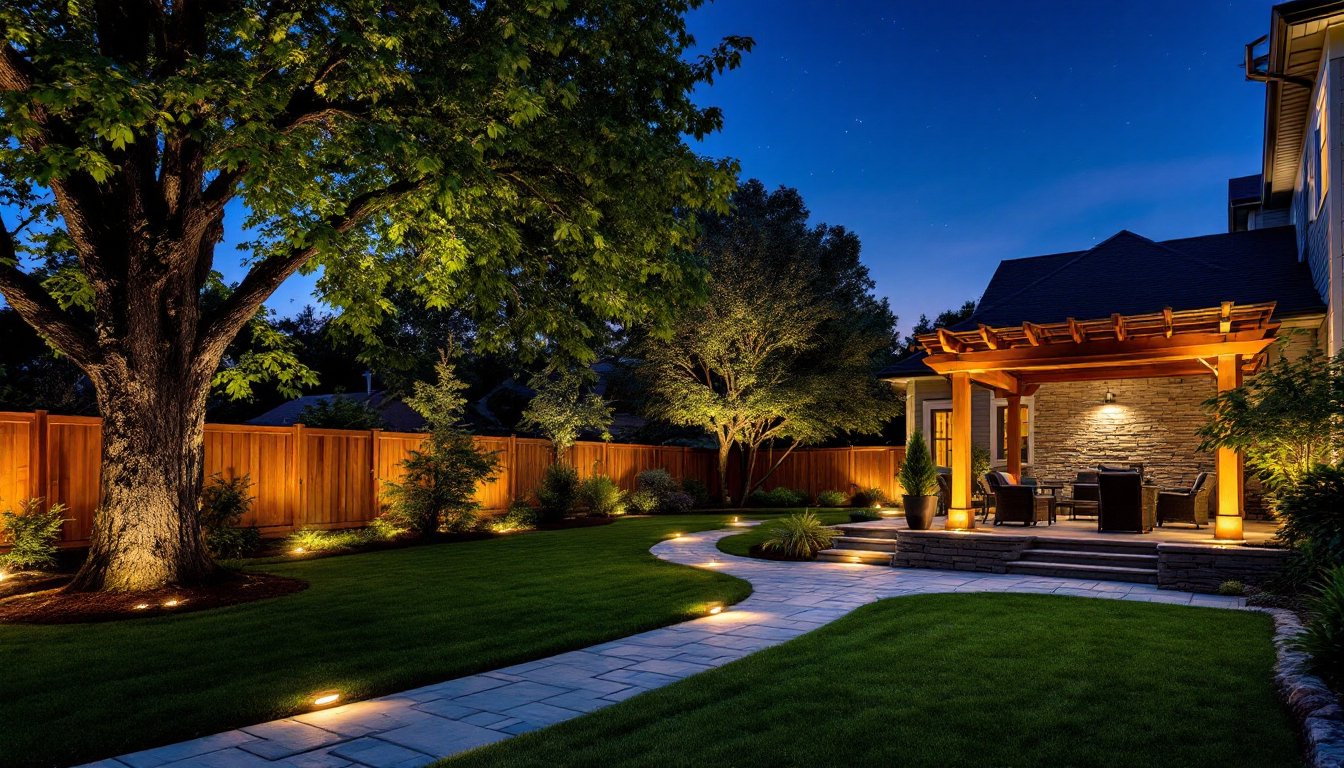
Uplighting is the go-to for trees, columns, and tall architectural features. Fixtures are placed at the base, aiming upward to emphasize height and texture. Narrow beams (10–15 degrees) work for slim trunks: wider floods (35–60 degrees) suit broader canopies or walls. LED uplights have largely replaced halogen for their efficiency and cooler operation, which is safer near plantings.
Downlighting or moonlighting mimics natural light by mounting fixtures high in trees or on eaves, casting gentle pools of light downward. This technique works well over seating areas or pathways. Use shielded fixtures to prevent glare and aim carefully to avoid harsh shadows.
Grazing highlights textured surfaces, stone, brick, stacked ledger panels, by placing a fixture close to the surface and aiming across it. The low angle exaggerates texture and creates drama. This works beautifully on feature walls, chimneys, or retaining walls.
Shadowing (or silhouette lighting) places the fixture behind an object (like an ornamental grass or sculpture) to cast a dramatic shadow on a wall or fence. It’s effective for adding visual interest in small spaces.
Path lighting includes both traditional hooded fixtures and low-profile bollards. Spacing is typically every 8 to 10 feet, depending on fixture output and path width. For a modern look, consider recessed lights in paver edges or linear strip lighting in handrails.
Water feature lighting uses submersible or sealed fixtures to illuminate fountains, ponds, or waterfalls. These must meet IP68 or equivalent ratings for continuous submersion. Colored LEDs are popular here but can look gimmicky if overdone, warm white usually ages better.
Choosing the Right Fixtures and Technology
Most residential custom landscape lighting runs on 12V AC low-voltage systems, which are safer to install and easier to troubleshoot than 120V line-voltage. A step-down transformer (typically 150W to 600W capacity) converts household current. Calculate total wattage of all fixtures and size the transformer with at least 20% overhead to prevent overload and voltage drop.
Voltage drop is a common problem on long wire runs. Use 12-gauge or 10-gauge direct-burial cable for main runs, not the thin 16-gauge wire included in some kits. NEC guidelines recommend keeping voltage drop under 3% for acceptable performance. Online calculators can help determine wire gauge for a given run length and load.
LED fixtures dominate the market now, offering 25,000 to 50,000-hour lifespans and consuming a fraction of the power of halogen. When selecting LEDs, pay attention to color temperature: 2700K to 3000K gives a warm, inviting glow similar to incandescent: 4000K and higher skews cool and clinical. CRI (Color Rendering Index) above 80 ensures colors look natural.
Fixture materials matter for longevity. Brass, copper, and stainless steel resist corrosion better than painted aluminum or plastic. Brass develops a patina over time: if that’s undesirable, look for powder-coated or PVD-finished options. Check IP (Ingress Protection) ratings, IP65 or higher is standard for outdoor use.
Smart controls are increasingly popular. Systems like Lutron, FX Luminaire, or Hunter integrate with home automation platforms, allowing app-based scheduling, dimming, and scene creation. Simpler options include basic photocell timers or astronomical timers that adjust on/off times based on sunrise and sunset throughout the year.
Planning Your Custom Landscape Lighting Project
Start by walking the property at dusk with a flashlight or portable LED work light. Use it to test potential fixture locations and beam angles. Take photos to reference later. Identify must-light features (entries, hazards, focal points) and nice-to-haves (decorative accents).
Sketch a site plan showing fixture locations, wire runs, and the transformer location. The transformer should be accessible (for bulb changes and troubleshooting), weather-protected, and near a GFCI-protected outlet. Wall-mount or pedestal-mount transformers keep them off the ground and away from sprinkler overspray.
Plan wire runs to minimize voltage drop. Run a main home-run cable from the transformer to the farthest fixture or hub, then branch off to individual fixtures. Use the “daisy chain” method cautiously, it works for a few fixtures but compounds voltage drop on long strings.
For installation, trench 6 to 12 inches deep for direct-burial cable, depending on local codes. Use a flat spade or trenching tool: a manual edger works well along bed lines. Avoid trenching through root zones of mature trees when possible. Lay cable in a smooth curve without kinks. Leave a service loop (extra 12 inches of slack) at each fixture for future adjustments.
Connect fixtures using waterproof wire connectors, not standard twist-on wire nuts. Silicone-filled or gel-filled connectors prevent moisture intrusion. Test the system before backfilling trenches, it’s much easier to troubleshoot aboveground.
Permits are rarely required for low-voltage landscape lighting, but always check local codes. If tying into household circuits or installing line-voltage fixtures, an electrician and permit may be necessary. Some HOAs have restrictions on fixture styles or light levels, so review covenants before purchasing.
Maintenance is straightforward. Clean lenses annually, check connections for corrosion, and trim back vegetation that blocks fixtures. LED bulbs last years, but when they do fail, replace with the same color temperature to maintain consistency. Adjust aim as plants mature or hardscape changes.