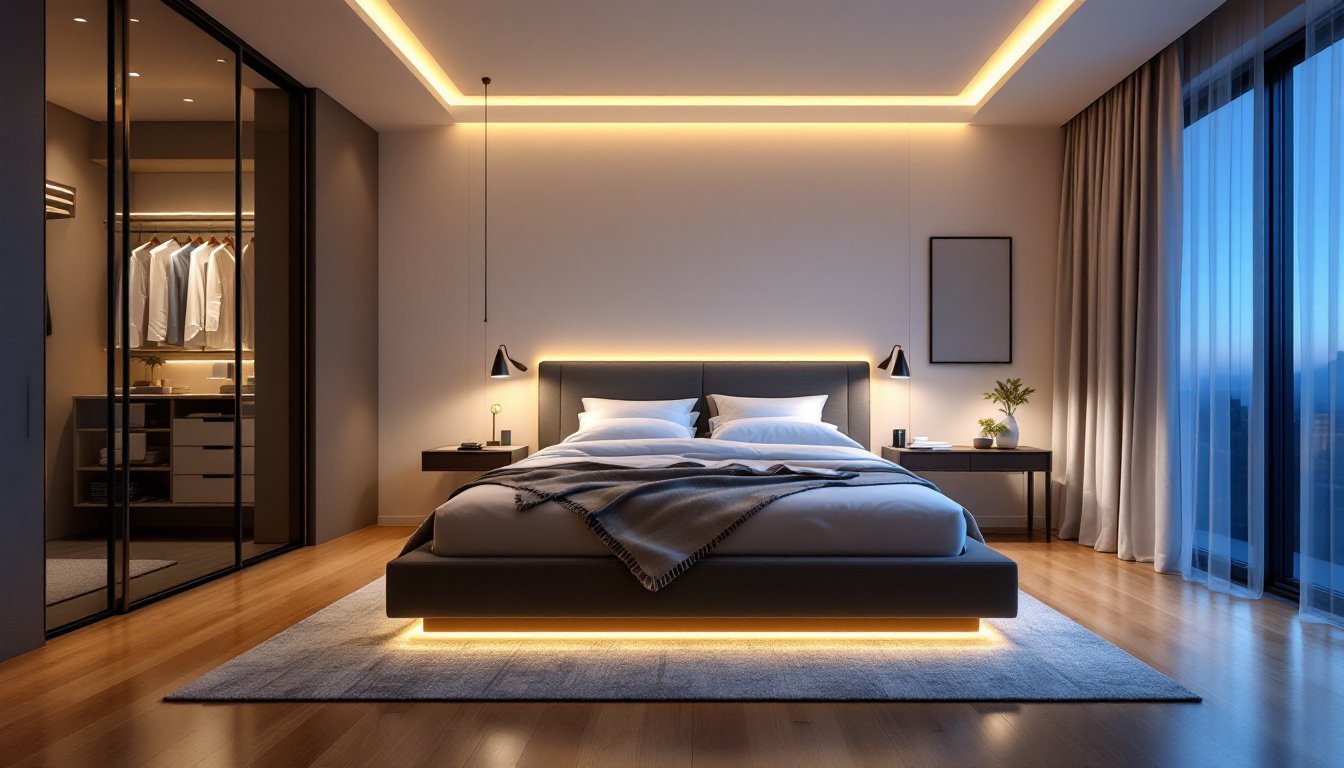
Bedroom lighting does more than just help someone find their slippers at 2 a.m. It sets mood, supports routines, and affects sleep quality. LEDs have reshaped what’s possible in residential lighting, they’re efficient, long-lasting, dimmable, and available in a spectrum of color temperatures that can shift a room from energizing to sleep-inducing with a simple adjustment. For anyone planning a bedroom refresh or building out a new space, LED technology offers practical solutions that weren’t on the table a decade ago. This guide walks through ambient, task, and statement lighting strategies using LEDs, with an eye toward both function and atmosphere.
Table of Contents
ToggleKey Takeaways
- LED bedroom lighting ideas offer 80-90% energy savings compared to incandescent bulbs while lasting 25,000 to 50,000 hours, reducing replacement frequency and utility costs.
- A layered approach combining ambient lighting (recessed cans, flush-mounts, or cove lighting), task lighting (reading lamps, vanity fixtures), and statement pieces creates both function and atmosphere.
- LED strip lights are versatile accent solutions for under-bed nightlighting, headboard backlighting, and closet illumination, with warm white (2700K) colors supporting healthy sleep cycles.
- Color temperature control—warm white (2700K-3000K) for evening relaxation and cooler tones (5000K+) for morning tasks—combined with dimmable fixtures enables circadian-aligned lighting routines.
- Smart LED lighting systems with dimming zones, motion sensors, and circadian features integrate with voice assistants to automate sleep-promoting routines while maximizing energy efficiency.
- Choose LED fixtures with 90+ CRI (Color Rendering Index) for accurate color representation, and always pair LED bulbs with LED-compatible dimmers to avoid flickering and ensure smooth dimming performance.
Why LED Lighting Is Perfect for Bedrooms
LEDs check every box for bedroom use. They draw a fraction of the energy that incandescent bulbs require, typically 80-90% less, which means lower utility bills and less heat output. That last point matters more than people think. Incandescent bulbs waste most of their energy as heat, which can make a small bedroom uncomfortable in summer months.
Life span is another major advantage. Quality LED bulbs are rated for 25,000 to 50,000 hours, compared to roughly 1,000 hours for incandescents. In a bedroom fixture used three hours per night, that’s over two decades before replacement. For recessed cans or fixtures mounted on tall ceilings, that longevity means fewer ladder trips.
LEDs also support dimming and color temperature control without the flicker issues that plagued early compact fluorescents. Dimmers compatible with LED technology (look for “LED-compatible” or “ELV” on the switch spec) allow smooth transitions from bright task lighting to a warm glow suitable for winding down. Many modern LED fixtures integrate tunable white technology, letting users shift between cooler daylight tones (5000K-6500K) for morning routines and warmer tones (2700K-3000K) for evening relaxation, all from the same fixture.
Ambient LED Lighting Ideas for a Relaxing Atmosphere
Ambient lighting provides general illumination without harsh shadows or glare. In a bedroom, it’s the foundation layer that makes the space usable after dark. LED options range from recessed ceiling cans to flush-mount fixtures and indirect cove lighting.
Recessed LED downlights remain the workhorse for ambient coverage. Four-inch or six-inch housings fit standard ceiling joists (spaced 16 inches or 24 inches on center) and accept LED retrofit kits or integrated LED units. Spacing them roughly 4 to 6 feet apart provides even coverage in a typical 12×14-foot bedroom. Choose fixtures with a 90+ CRI (Color Rendering Index) to ensure fabrics, artwork, and skin tones look natural.
For rooms where recessed lights aren’t feasible, old plaster ceilings, low attic clearance, flush or semi-flush LED ceiling fixtures deliver wide, diffused light. Look for models with an acrylic or frosted glass diffuser to eliminate hotspots. Many now include built-in dimming drivers that work with standard wall dimmers.
Cove lighting uses LED strips concealed behind crown molding or a shallow ledge to wash the ceiling with indirect light. This approach creates a soft, hotel-like glow that’s easy on the eyes. It requires a shallow cove or soffit (2-3 inches deep), low-voltage LED strip (typically 12V or 24V), and a compatible driver or power supply tucked out of sight. Because the light bounces off the ceiling, paint color matters, flat white reflects better than darker or glossy finishes.
LED Strip Lights for Accent and Mood Lighting
LED strip lights (also called tape lights or ribbon lights) are the Swiss Army knife of bedroom lighting. They’re adhesive-backed, flexible, and available in a range of densities measured in LEDs per foot, 60 LEDs/foot for general accent work, 120+ for more continuous, uniform glow.
Common bedroom applications include:
- Under-bed lighting: Mounting strips along the bed frame or platform base provides a subtle nightlight effect and makes late-night navigation safer. Use warm white (2700K) to avoid disrupting circadian rhythm.
- Behind headboards or artwork: Backlighting a fabric headboard or large canvas creates depth and visual interest without requiring additional floor space for lamps.
- Inside closets or wardrobes: Motion-activated LED strips make it easy to see clothing details without overhead glare.
Installation is straightforward. Most strips come with 3M adhesive backing, but for permanent or high-temperature locations (near heating vents), add aluminum channel track for better heat dissipation and a cleaner look. Always use a compatible power supply matched to the strip’s voltage and total wattage. For a 16-foot run of 12V strip drawing 4.8 watts per foot, that’s roughly 77 watts, choose a driver rated for at least 90-100 watts to avoid overloading.
RGB or RGBW strips allow color changes via remote or app control. While fun for accent lighting, they’re less suitable as primary bedroom light sources. The white channel on RGBW strips often has a lower CRI than dedicated warm-white strips, so colors may look washed out.
Task Lighting Solutions with LED Technology
Task lighting targets specific activities, reading in bed, applying makeup, getting dressed. LEDs excel here because they produce focused, glare-free light without the bulk or heat of older halogen fixtures.
Adjustable LED reading lamps mounted to the wall or headboard keep nightstands clear and direct light exactly where it’s needed. Look for models with a gooseneck or articulating arm and a shade that shields the bulb from a partner’s line of sight. Many include built-in dimmers or touch controls. A lamp producing 300-500 lumens at the reading surface (roughly equivalent to a 40W incandescent) is adequate for most people.
LED vanity lights flanking a bedroom mirror should provide even, shadow-free illumination. Fixtures with frosted or opal glass shades diffuse the light and reduce hotspots. Mount them at eye level, about 60-65 inches off the floor, and space them to bracket the mirror width. For color accuracy, critical when matching clothing or applying makeup, choose bulbs rated 90 CRI or higher in a 3000K-4000K range (neutral to warm white).
For walk-in closets or dressing areas, LED track lighting or adjustable puck lights offer flexibility. Track systems let you reposition heads as storage layouts change. Puck lights work well inside custom closets or mounted under upper shelves to light hanging rods below. Use battery-powered LED pucks with motion sensors for quick retrofits where running new wiring isn’t practical.
One often-overlooked detail: avoid placing task lights on the same switch or circuit as ambient lighting. Independent control lets someone read or get ready without flooding the entire room with light.
Statement LED Fixtures That Elevate Your Bedroom Design
Not every fixture has to be purely functional. Statement LED pendants and chandeliers anchor a room’s design while providing ambient or task light. Modern LED technology allows for bold, sculptural designs that would overheat or sag under the weight of traditional bulbs.
LED pendant lights hung as bedside task lighting replace table lamps and free up nightstand real estate. Suspend them 18-24 inches above the mattress surface so the bottom of the shade is roughly at seated eye level. Hardwiring requires a junction box in the ceiling, but plug-in kits with ceiling hooks and cord management offer a renter-friendly alternative.
Linear LED chandeliers work well over the foot of a bed or in the center of a large primary bedroom. Choose fixtures with an overall length proportional to the room, a common guideline is to add the room’s length and width in feet, then convert that sum to inches for the fixture diameter or length (e.g., a 12×14-foot room suggests a fixture around 26 inches). For bedrooms with 8-foot ceilings, opt for low-profile or flush designs to maintain headroom.
Integrated LED fixtures, where the light source is permanent and non-replaceable, have become the norm in statement pieces. While the LEDs last decades, the entire fixture must be replaced if the driver or LEDs fail. Check the manufacturer’s warranty (reputable brands offer 5+ years) and confirm replacement parts or modules are available.
Artistic LED wall sconces flanking the bed or dressing area add symmetry and style. Dimmable sconces with adjustable heads serve double duty as task and ambient sources. Mounting height depends on function: 54-60 inches for reading, slightly higher for pure ambiance.
Smart LED Lighting Features for Modern Bedrooms
Smart LED systems integrate with home automation platforms, voice assistants, and smartphone apps. The benefits go beyond convenience, they enable lighting routines that support better sleep hygiene and energy savings.
Smart bulbs and fixtures connect via Wi-Fi, Zigbee, or Z-Wave protocols. Popular options include bulbs compatible with Amazon Alexa, Google Home, or Apple HomeKit. Once connected, users can schedule lights to dim gradually before bedtime, simulate sunrise to ease waking, or turn off automatically when everyone leaves the house.
Circadian lighting features adjust color temperature throughout the day to align with natural light cycles. Morning settings use cooler, blue-enriched light (5000K+) to promote alertness, while evening modes shift to warm amber tones (2200K-2700K) that minimize melatonin suppression. Some systems automate this transition based on local sunrise/sunset times.
Installation varies by product. Smart bulbs screw into existing fixtures and connect through an app, no rewiring needed. Smart switches replace standard wall switches and control all bulbs on that circuit, smart or not. Neutral wires are required for most smart switches: older homes wired with switch loops may need a retrofit or alternative wireless switch that doesn’t require a neutral.
Motion and occupancy sensors paired with LED fixtures are useful in closets, en-suite bathrooms, or hallways leading to bedrooms. They provide hands-free lighting while cutting energy waste. Adjust sensitivity and timer duration to avoid lights shutting off mid-task.
One caution: smart features add complexity. If a system depends on a cloud service or proprietary hub that’s discontinued, functionality may be lost. Look for products that support open standards like Matter (a new cross-platform protocol) or can operate locally without internet access.
Color Temperature and Dimming Tips for Better Sleep
The wrong color temperature can undermine a bedroom’s function. Color temperature, measured in Kelvin (K), describes how warm (yellowish) or cool (bluish) a light source appears. Bedrooms benefit from a layered approach: cooler tones for waking and tasks, warmer tones for relaxation.
2700K-3000K (warm white) mimics the glow of incandescent bulbs and traditional evening lighting. It’s ideal for ambient and bedside lighting after sunset. Research suggests warm light with minimal blue spectrum content supports melatonin production, which regulates sleep onset.
3500K-4000K (neutral white) offers a balance suitable for task lighting, vanities, closets, or workspaces within the bedroom. It provides clarity without the clinical feel of daylight bulbs.
5000K+ (daylight or cool white) is too stimulating for most bedroom settings but can be useful in walk-in closets or dressing areas used primarily in the morning.
Dimming extends the versatility of any LED fixture. Not all LEDs dim smoothly, cheap bulbs may flicker, buzz, or drop out abruptly at low levels. Look for bulbs explicitly labeled “dimmable” and pair them with LED-compatible dimmers. Lutron, Leviton, and Legrand make reliable dimmers with smooth fade curves. For best performance, keep the total load within the dimmer’s rated range (typically 150W minimum for LEDs).
A well-designed bedroom lighting plan includes at least two dimming zones: one for overhead ambient fixtures and another for bedside or task lights. This allows fine-tuned control without rewiring multiple switches.
Avoid using LED bulbs on dimmers not rated for LED use, they’re designed for resistive loads (incandescent bulbs) and can cause premature LED failure or create electrical noise. If retrofitting an older dimmer, replacing it with an LED-compatible model is a straightforward swap that takes under 15 minutes, assuming basic electrical skills and the power is shut off at the breaker.