Most homeowners invest heavily in landscaping, decking, and outdoor furniture, then wonder why their backyard feels lifeless after sunset. The missing piece isn’t more plants or a bigger patio. It’s decorative outdoor lighting. Thoughtfully placed fixtures don’t just illuminate walkways: they create ambiance, extend usable hours, and highlight architectural features that disappear in the dark. Whether someone’s hosting a summer barbecue or simply wants to enjoy their yard past dusk, the right lighting transforms an ordinary outdoor space into an inviting evening retreat.
Table of Contents
ToggleKey Takeaways
- Decorative outdoor lighting transforms ordinary backyards into inviting evening retreats while serving three core purposes: safety, security, and aesthetic ambiance.
- String lights and path lights are the most popular decorative outdoor lighting options, with string lights requiring solid support points every 10–15 feet and path lights spaced 6–8 feet apart for consistent walkway illumination.
- Choose warm white color temperature (2700K–3000K) for residential entertaining spaces and select fixtures rated IP65 or higher for weather resistance, especially in coastal or harsh climates.
- Low-voltage wired systems (12V/24V) deliver reliable brightness and work with timers, while solar lights suit garden accents; line-voltage (120V) systems require professional installation and permits.
- Proper planning—laying out fixtures during daylight and testing with a flashlight after dark—prevents spacing issues and ensures decorative outdoor lighting achieves both functional and visual goals.
- Maintenance such as quarterly lens cleaning, annual wire inspections, and replacing LED bulbs after 15,000–25,000 hours extends fixture lifespan and preserves the investment in your outdoor space.
Why Decorative Outdoor Lighting Matters for Your Home
Outdoor lighting serves three core purposes: safety, security, and aesthetics. Decorative fixtures lean into that third function while still addressing the first two.
From a practical standpoint, well-lit paths, steps, and entryways reduce trip hazards and deter unwanted visitors. Motion-sensor floods handle security, but decorative lighting keeps the space functional without the harsh glare of utility fixtures. A series of path lights along a garden walkway prevents twisted ankles while adding visual interest.
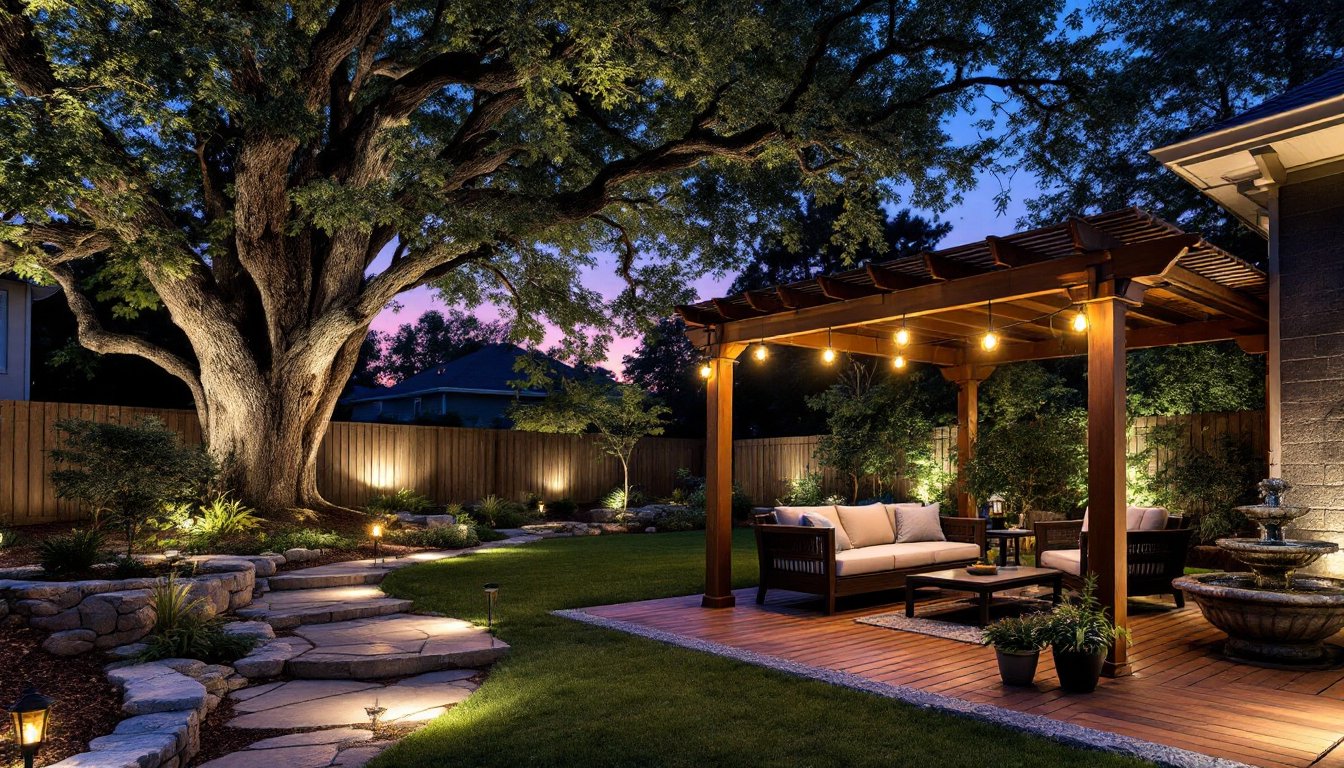
Aesthetically, decorative lighting creates layers. Uplighting a mature tree adds drama. String lights soften hard edges on fences and pergolas. Low-voltage spotlights showcase stonework or water features. These layers give depth to a yard that would otherwise flatten into silhouettes after dark.
There’s also a financial angle. Quality outdoor lighting boosts curb appeal, which matters for resale value. Buyers notice a thoughtfully lit exterior, it signals that the homeowner maintained the property beyond the basics. According to the National Association of Home Builders, outdoor lighting ranks among the top ten features buyers want in a new home.
Finally, decorative lighting extends the functional use of outdoor spaces. A deck with overhead string lights becomes an evening dining area. A pool surrounded by lanterns stays inviting past twilight. Without lighting, those investments sit idle half the day.
Popular Types of Decorative Outdoor Lighting
The decorative lighting market offers dozens of fixture styles, but most projects revolve around a few proven categories. Understanding their strengths helps homeowners match fixtures to function.
String Lights and Bistro Bulbs
String lights, often called bistro lights or café lights, remain the most popular decorative option for patios, decks, and pergolas. They provide ambient illumination without the intensity of overhead fixtures.
Most outdoor string sets use Edison-style bulbs (often LED replicas) spaced 12 to 24 inches apart on 18- to 48-foot strands. Commercial-grade sets feature rubberized or plastic sockets rated for wet locations (look for IP65 or higher). Cheaper sets use non-replaceable bulbs and fail within a season: invest in replaceable-bulb systems with shatterproof plastic or glass globes.
Installation requires support points every 10 to 15 feet to prevent sagging. Use galvanized eye hooks screwed into studs or joists, not just fascia boards. For longer runs without mid-span posts, consider steel suspension cable as a primary support, then clip the light strand to the cable with zip ties or purpose-made clips.
String lights draw modest power, typically 0.5 to 1 watt per LED bulb. A 48-foot strand with 24 bulbs pulls roughly 12 to 24 watts total, meaning a single 15-amp outdoor circuit can handle multiple strands. Always plug into a GFCI-protected outlet.
Lanterns and Path Lights
Lanterns come in two formats: freestanding (on posts or stakes) and hanging (from hooks or overhead structures). Solar-powered lanterns suit low-traffic areas where brightness isn’t critical, most output 5 to 15 lumens, enough for accent lighting but not task lighting. For reliable performance, choose wired low-voltage lanterns (12V or 24V systems) with LED bulbs rated at 3 to 5 watts each.
Path lights (also called bollard lights or landscape lights) line walkways, driveways, and garden borders. Standard spacing runs 6 to 8 feet apart, though this varies with bulb brightness and beam spread. Low-voltage path lights install via a transformer system, stepping household 120V down to 12V or 24V for safer buried cable runs.
Most path light kits include a transformer rated at 60 to 300 watts. Calculate total wattage before buying: ten 5-watt fixtures require at least a 50-watt transformer, but allow 20% headroom (so a 60-watt minimum). Use 14- or 12-gauge landscape wire for runs over 50 feet to minimize voltage drop.
Stake-style path lights press into soil, but they wobble in loose or sandy ground. For stability, dig a 4-inch-deep hole, insert the stake, then backfill and tamp. In hardscaping areas, consider surface-mount bollards with concrete bases.
How to Choose the Right Decorative Lighting for Your Space
Selecting fixtures starts with mapping the yard by function: entertainment zones, pathways, focal points, and security areas. Each demands different brightness, beam angles, and fixture styles.
Entertainment zones (decks, patios, seating areas) benefit from soft, diffused light. Aim for 1 to 2 watts per square foot with string lights or overhead lanterns. Avoid downlights directly above seating, they create harsh shadows on faces. Instead, use cross-lighting or perimeter fixtures.
Pathways need consistent, low-level illumination. Position path lights to one side of the walkway, not both (staggered on alternating sides works, or a single line along the dominant edge). For steps, install lights at tread level or just below the riser to define edges without glare.
Focal points, trees, sculptures, water features, require directional spotlights with narrow beam spreads (15 to 30 degrees). Uplighting a tree trunk from 2 to 4 feet away creates dramatic shadows in the canopy. Use 3- to 5-watt LED spots for small trees, 7 to 10 watts for specimens over 20 feet tall.
Material and weather resistance matter more outdoors than in any interior application. Look for fixtures rated IP65 or higher (dust-tight and water-jet resistant). Coastal areas demand corrosion-resistant finishes: powder-coated aluminum, stainless steel, or solid brass. Plastic housings crack in UV exposure and temperature swings: they’re fine for seasonal decor but not permanent installations.
Color temperature affects ambiance. Warm white (2700K to 3000K) suits residential settings, it mimics incandescent bulbs and flatters skin tones. Cool white (4000K+) feels clinical and works better for security lighting than entertaining.
Power source is a practical decision. Solar lights require no wiring but depend on sunlight exposure and battery health. They’re ideal for garden accents or remote areas. Low-voltage wired systems (12V/24V) deliver consistent brightness and work with timers or smart controls. Line-voltage (120V) systems offer the brightest output but require GFCI protection and often an electrician for installation, and possibly a permit, depending on local codes.
Installation Tips and Best Practices
DIY installation is feasible for most low-voltage and solar systems. Line-voltage work (120V) often requires a licensed electrician and electrical permits, especially for new circuits or buried conduit. Check local codes before digging or wiring.
Layout and planning comes first. Lay out fixtures on the ground during daylight, then revisit after dark with a flashlight to simulate beam angles and coverage. This step catches spacing issues before any digging.
Low-voltage installation starts with the transformer. Mount it near a GFCI outlet, indoors or in a weatherproof enclosure. Many transformers include timers or photocell sensors: set the timer to turn off after midnight to save energy.
Bury landscape wire 6 inches deep minimum (some jurisdictions require 12 inches). Use a flat-blade spade to cut a narrow trench. Avoid running wire under driveways or heavy traffic areas. If crossing a path, sleeve the wire in Schedule 40 PVC conduit for protection.
Connect fixtures using twist-on wire connectors or manufacturer-supplied quick-connect clips. Leave 6 to 12 inches of slack at each fixture for future adjustments. Strip wire ends cleanly with a wire stripper, ragged cuts corrode faster.
String light installation requires solid anchor points. For wood structures, screw galvanized eye hooks into joists or beams, not just into sheathing or trim. Pre-drill pilot holes to prevent splitting. For masonry, use stainless steel sleeve anchors rated for outdoor use.
If spanning more than 15 feet, add a mid-span support post or run 1/8-inch stainless steel cable as a suspension line. Tension the cable with a turnbuckle until taut, then attach the light strand with clips.
Safety notes: Always wear gloves and safety glasses when digging or drilling. When working with electricity, shut off the circuit at the breaker, not just the switch. Use a non-contact voltage tester to confirm power is off. Never bury standard extension cords, use only direct-burial-rated cable.
Maintenance extends fixture life. Clean lenses and solar panels quarterly with soapy water. Check wire connections annually for corrosion. Replace LED bulbs when they dim (typically after 15,000 to 25,000 hours), not just when they fail. Tighten stakes after freeze-thaw cycles.
Conclusion
Decorative outdoor lighting isn’t a luxury, it’s a practical upgrade that makes a yard safer, more functional, and more enjoyable. With the right fixtures, proper installation, and a clear plan, any homeowner can extend their living space well past sunset. Start with one zone, test the layout before committing, and don’t skip the prep work. The evening view is worth the effort.