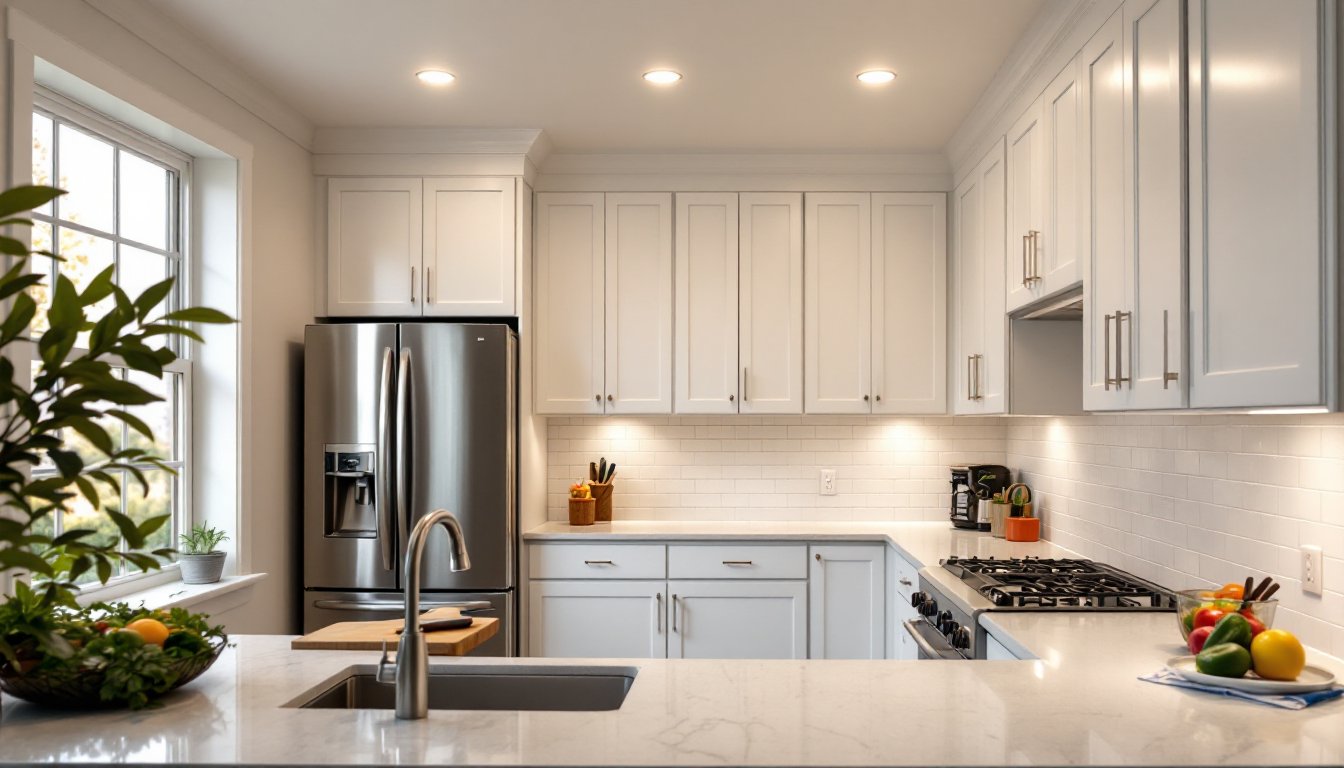
Most homeowners underestimate how much good overhead lighting transforms a kitchen. It’s not just about seeing what’s on the cutting board, proper ceiling fixtures eliminate shadows, make spaces feel larger, and set the tone for the most-used room in the house. Poor lighting, on the other hand, creates dark corners, eye strain, and a kitchen that feels like a basement. With LED technology advancing and fixture styles diversifying, 2026 offers more options than ever, but also more confusion. This guide walks through the types, placement strategies, and installation realities that separate well-lit kitchens from dim compromises.
Table of Contents
ToggleKey Takeaways
- Kitchen overhead lighting eliminates shadows and makes spaces feel larger while meeting the Illuminating Engineering Society’s recommended 30–40 foot-candles for general tasks.
- Recessed lights, track lighting, and flush mounts each offer distinct advantages—recessed for minimalist aesthetics, track for flexibility, and flush mounts for renters or ceilings below 8 feet.
- Proper overhead lighting placement requires spacing fixtures 4–6 feet apart and positioning the first fixture 18–24 inches from walls to prevent dark perimeter areas.
- Choose color temperature based on kitchen style: 3000K (warm white) for traditional kitchens, 4000K (neutral white) for modern designs, with a CRI of 90+ for accurate food and finish colors.
- Upgrading to LED overhead lighting improves resale value, requires LED-compatible dimmers to avoid flicker, and offers either integrated long-lasting options or replaceable bulb systems for flexibility.
- For complex installations involving new wiring or circuits, hiring a licensed electrician ensures compliance with National Electrical Code standards and local permit requirements.
Why Kitchen Overhead Lighting Matters More Than You Think
Overhead lighting serves as the foundation of a kitchen’s lighting design. Unlike under-cabinet task lights or pendant fixtures over an island, ceiling-mounted lights provide ambient illumination, the base layer that fills the entire room.
Without adequate overhead lighting, a kitchen becomes a patchwork of bright spots and shadows. Try chopping vegetables under a single pendant fixture and the cook’s body blocks the light. Rely only on under-cabinet strips and the center of the room stays dark. Overhead fixtures solve this by distributing light from above, reaching counters, floors, and vertical surfaces.
Kitchens also demand higher light levels than most rooms. The Illuminating Engineering Society (IES) recommends 30–40 foot-candles for general kitchen tasks, with task areas requiring 70–80 foot-candles. Overhead lighting does the heavy lifting to meet these baselines. Skimping here forces eyes to strain and makes prep work harder than it needs to be.
Good overhead lighting also affects resale value. Buyers notice dark kitchens immediately. A well-lit space photographs better, feels more inviting during showings, and signals that the home’s been maintained. Upgrading fixtures is one of the more affordable improvements that delivers visible impact.
Types of Kitchen Overhead Lighting to Consider
Choosing the right fixture type depends on ceiling height, kitchen size, and personal style. Each category has trade-offs in installation complexity, light distribution, and aesthetics.
Recessed Lighting and Track Lighting
Recessed lights (often called can lights) sit flush with the ceiling, making them ideal for kitchens with low ceilings or a minimalist look. Modern LED retrofit kits make installation simpler, many require only a 2-inch ceiling depth and clip into existing housings. Standard 4-inch or 6-inch housings are most common: 4-inch cans work in galley kitchens, while 6-inch provide broader coverage in larger spaces.
Recessed lighting shines when layered. A typical layout uses one fixture every 4–6 feet, staggered to avoid harsh shadows. Dimmable LED retrofits (typically 650–850 lumens per fixture at 3000K–4000K color temperature) give control over brightness. One downside: recessed lights penetrate the ceiling, which affects insulation and requires cutting into drywall. In older homes, this may mean dealing with wiring that’s not up to current National Electrical Code (NEC) standards. If the circuit lacks a ground or uses outdated junction boxes, an electrician should handle upgrades.
Track lighting offers flexibility without cutting holes. Tracks mount to the ceiling’s surface and hold adjustable heads that pivot to direct light where needed. They’re excellent for kitchens with changing layouts, move a head to highlight a new countertop appliance or redirect it after rearranging cabinets. Track systems come in single-circuit (all lights on one switch) or multi-circuit (independent control). Installation is straightforward if there’s already a ceiling junction box: the track mounts with screws into joists or drywall anchors rated for the fixture’s weight.
Both options handle kitchens well, but recessed lights disappear visually while track fixtures remain part of the design. Choose recessed for clean lines, track for adaptability.
Flush Mount and Semi-Flush Mount Fixtures
Flush mount fixtures sit directly against the ceiling with no gap, while semi-flush mounts hang a few inches down on a short stem or chain. Both styles work in kitchens where recessed lighting isn’t practical, renters, homes with limited ceiling access, or spaces where cutting into the ceiling risks damaging radiant heating or structural elements.
Flush mounts suit kitchens with ceilings below 8 feet. They provide broad, even light without anyone hitting their head. Look for fixtures with diffusers (frosted glass or acrylic) rather than exposed bulbs, diffusers reduce glare and spread light more evenly. A typical 12–16 inch diameter flush mount covers about 100–150 square feet, so a 10×12 kitchen may need two fixtures.
Semi-flush mounts add a bit of style and work best in kitchens with 8–9 foot ceilings. The slight drop creates visual interest without the hazard of full pendant lights. They’re also easier to clean than recessed cans, since the fixture’s accessible without a ladder and ceiling cutout.
Installation for both types connects to a standard ceiling junction box. The key is making sure the box is properly secured to a joist or blocking, not just hanging from drywall. A loose box will sag over time, especially with heavier semi-flush fixtures. If replacing an old fixture, check that the existing box is rated for the new fixture’s weight, most modern boxes handle up to 50 pounds, but older pancake boxes may max out at 10.
How to Choose the Right Overhead Lighting for Your Kitchen Layout
Layout dictates fixture selection more than aesthetics. A galley kitchen has different needs than an open-plan space, and ignoring those differences leads to uneven lighting.
Galley kitchens (narrow, with cabinets on two sides) benefit from a single row of recessed lights down the center or a linear track fixture. Space fixtures 4 feet apart to avoid dark zones between counters. Avoid placing lights directly over the aisle, they’ll create glare on reflective surfaces. Instead, offset them slightly toward the counter edges.
L-shaped and U-shaped kitchens need coverage in multiple zones. Use a combination of recessed lights in a grid pattern (roughly 5–6 feet apart) or a central semi-flush mount supplemented by under-cabinet task lighting. The goal is eliminating shadows in corners where upper and lower cabinets meet.
Open-plan kitchens with islands or peninsulas require layered lighting. Overhead fixtures handle general illumination, but island pendants (though not overhead lighting per se) add task light directly over work surfaces. If going with recessed lights, plan a perimeter row around the kitchen’s edge and a second row along the island’s length. This creates even coverage without relying on a single central fixture.
Ceiling height also matters. Ceilings above 9 feet need fixtures with higher lumen output or more fixtures overall, since light disperses over a greater distance. For every additional foot of ceiling height, increase lumens by roughly 10–15% to maintain the same brightness at counter level.
Color temperature affects how the kitchen feels. 3000K (warm white) works in traditional kitchens with wood cabinets and warmer finishes. 4000K (neutral white) suits modern spaces with white or gray cabinetry, it’s bright without the sterile feel of 5000K+ found in commercial settings. The Color Rendering Index (CRI) should be 90 or above to accurately show food colors and finishes.
Installation Tips and Placement Best Practices
Installing overhead lighting isn’t always DIY territory. If the project involves running new wiring, adding circuits, or working in a ceiling with complicated framing, hiring a licensed electrician is the safer, and often required, route. Many jurisdictions require permits for new electrical runs or circuit additions, and inspection ensures work meets NEC standards.
That said, replacing an existing fixture with a similar one (like swapping an old flush mount for a new LED version) is manageable for most homeowners with basic electrical knowledge. Always shut off power at the breaker, verify it’s off with a non-contact voltage tester, and confirm the junction box is properly secured before hanging anything.
Placement guidelines:
- Recessed lights: Position the first fixture 18–24 inches from the wall, then space additional fixtures 4–6 feet apart. This prevents the “cave effect” where perimeter areas stay dark.
- Flush/semi-flush mounts: Center them in the room or over key work zones. In larger kitchens, use two fixtures rather than one oversized piece, it improves light distribution.
- Track lighting: Mount tracks parallel to counters, about 12–18 inches from the cabinet face. Angle heads to graze the backsplash and countertop without shining directly into eyes.
Safety notes: Wear safety glasses when drilling into ceilings, debris falls fast. Use a stud finder to locate joists before cutting recessed light holes or mounting tracks. If working in an attic space above the kitchen, lay boards across joists to avoid stepping through drywall. For fixtures in contact with insulation, use IC-rated (insulation contact) housings to prevent fire risk.
If installing dimmable LEDs, verify the dimmer switch is LED-compatible. Older incandescent dimmers cause LED flicker and buzzing. Modern LED dimmers cost $15–$30 and install the same way as standard switches.
Finally, consider future bulb replacement. Integrated LED fixtures (where the LED is built-in) last 20+ years but require replacing the entire fixture when they fail. Fixtures with replaceable LED bulbs offer more flexibility, though they’re slightly less efficient.
Conclusion
Kitchen overhead lighting isn’t glamorous, but it’s the backbone of a functional space. The right fixtures, whether recessed cans, track systems, or flush mounts, make cooking safer, the room more inviting, and the home more valuable. Measure twice, respect electrical codes, and don’t skip the prep work. A well-lit kitchen pays dividends every single day.