Most homeowners don’t realize how much usable closet space they’re losing simply because they can’t see it. A single overhead bulb casts shadows in corners, behind hanging clothes, and along shelves, turning storage into a guessing game. Track lighting solves this problem by delivering adjustable, directional light exactly where it’s needed. Unlike fixed ceiling fixtures, track systems allow users to position multiple heads along a single circuit, illuminating dark zones without rewiring the entire closet. This guide covers system types, selection criteria, installation basics, and placement strategies to transform poorly lit storage into functional, visible space.
Table of Contents
ToggleKey Takeaways
- Closet track lighting eliminates shadows and dark zones by positioning adjustable light heads along a single circuit, transforming poorly lit storage into functional, visible space.
- Choose line-voltage systems for simplicity and bulb flexibility, or low-voltage systems for energy efficiency and heat reduction in tight spaces near stored items.
- Plan one light head for every 24 to 30 inches of track, using LED bulbs at 3000K to 3500K color temperature for accurate clothing color matching.
- Mount track perpendicular to ceiling joists and follow NEC clearances (12 inches from combustibles for non-enclosed fixtures, 6 inches for fully enclosed LED heads) to ensure safety and code compliance.
- Strategic track placement—such as parallel to hanging rods, around walk-in perimeters, or vertically on narrow closet walls—maximizes visibility and eliminates shadow zones across the entire closet.
What Is Closet Track Lighting and Why Choose It?
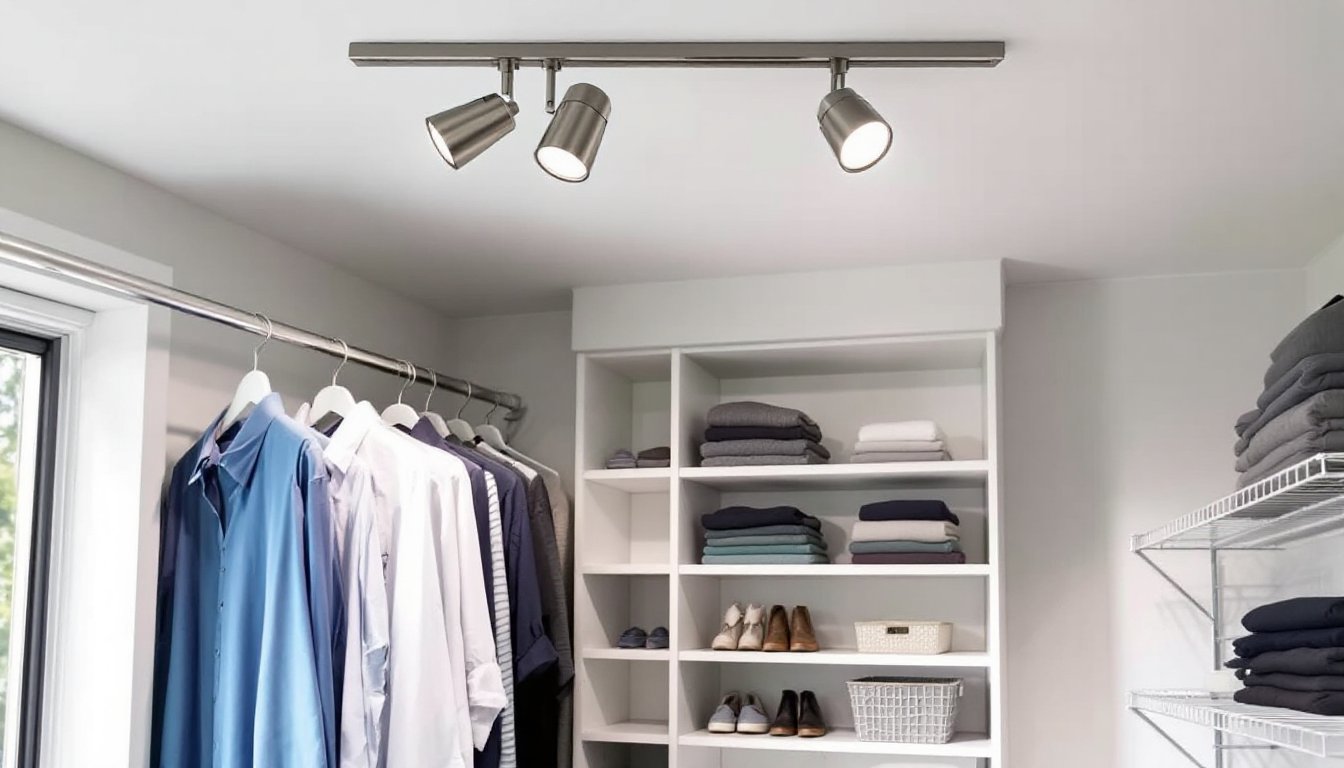
Closet track lighting consists of a linear rail (the track) mounted to the ceiling or wall, with adjustable light heads that slide and rotate along its length. Each head connects to the track’s internal conductors, drawing power from a single junction box. This setup offers several advantages over traditional closet lighting:
- Directional control: Heads pivot and tilt, directing light onto shelves, rods, or floor areas instead of creating a single pool of overhead light.
- Scalability: Most track systems accept multiple heads on one circuit, so users can add or remove fixtures as storage needs change.
- Shadow reduction: By positioning heads at different points along the track, users eliminate the shadow zones common with center-mounted fixtures.
- Aesthetic flexibility: Track lighting suits both modern reach-in closets and larger walk-ins, complementing wire shelving, built-ins, or custom millwork.
Track lighting works especially well in closets deeper than 24 inches or those with multiple hanging rods, where a single bulb can’t reach back corners. It’s also a practical retrofit option, many systems install over existing junction boxes without additional electrical work, assuming the circuit can handle the combined wattage of all heads.
Types of Track Lighting Systems for Closets
Track lighting falls into two primary categories, each with distinct installation requirements and performance characteristics.
Low-Voltage vs. Line-Voltage Track Systems
Line-voltage systems operate at 120 volts AC, connecting directly to standard household wiring. They’re straightforward to install, accept a wide range of bulb types (LED, halogen, incandescent), and don’t require transformers. Line-voltage tracks are available in lengths from 2 to 8 feet, with heads that handle bulbs up to 75 watts (though LED equivalents are now standard). These systems suit most closet applications and offer the simplest path from junction box to track.
Low-voltage systems run at 12 or 24 volts DC, requiring a transformer between the junction box and the track. The transformer converts household current to the lower voltage, which powers smaller, often more compact LED heads. Low-voltage tracks are cooler to the touch, more energy-efficient, and safer in tight spaces where users might brush against fixtures. The trade-off: transformers add cost and take up space, and replacement heads must match the system’s voltage.
For walk-in closets with ample ceiling height, line-voltage systems provide flexibility and easier bulb replacement. In smaller reach-in closets or applications near flammable materials (stored linens, seasonal clothing), low-voltage systems reduce heat output and fire risk. Note that the National Electrical Code (NEC) permits both types in closets, provided fixtures maintain clearances: 12 inches from stored items for surface-mounted incandescent or halogen, 6 inches for recessed or fully enclosed LED fixtures (NEC 410.16).
How to Choose the Right Track Lighting for Your Closet
Selecting a track system requires matching the fixture to the closet’s dimensions, existing wiring, and storage layout.
Track length and configuration: Measure the closet’s longest dimension. A track should span at least two-thirds of that length to distribute light evenly. For closets wider than 6 feet, consider an L-shaped or U-shaped track that wraps around corners, or install two parallel tracks. Most manufacturers offer 2-foot, 4-foot, and 8-foot sections that connect end-to-end with joiners.
Head count and spacing: Plan one light head for every 24 to 30 inches of track. A standard 6-foot-wide walk-in might use three heads: one at each end and one in the center. For closets with both hanging rods and shelving, add extra heads to target those specific zones.
Bulb type and color temperature: LED bulbs are the default choice, long-lasting (20,000+ hours), low heat, and available in color temperatures from 2700K (warm white) to 5000K (daylight). For accurate color matching of clothing, choose 3000K to 3500K, which renders fabrics naturally without the yellow cast of incandescent or the clinical blue of high-Kelvin LEDs. Ensure the combined wattage of all heads doesn’t exceed the circuit’s capacity: most bedroom circuits are 15 amps, supporting up to 1,800 watts (though LED systems rarely approach that limit).
Finish and mounting: Track systems come in white, black, brushed nickel, and other finishes. Match the finish to closet hardware (rods, brackets) for a cohesive look. Ceiling-mount tracks are most common, but wall-mount or cable-suspended systems work in closets without accessible ceiling joists.
Compatibility with existing wiring: If the closet already has a junction box and wall switch, verify that the box is rated for the weight and heat of the new track (code requires boxes to support at least 50 pounds for ceiling fixtures). If no junction box exists, installation will require running new wiring, typically a job for a licensed electrician unless the homeowner is comfortable working with branch circuits and pulling permits.
Installation Guide: Setting Up Closet Track Lighting
Installing track lighting is a manageable DIY project for homeowners comfortable with basic electrical work. Always turn off power at the breaker before starting.
Tools and materials:
- Track lighting kit (track, heads, mounting hardware, wire connectors)
- Voltage tester (non-contact type for safety)
- Drill/driver, ⅛-inch and ¼-inch bits
- Screwdriver, wire strippers
- Stud finder (if mounting to ceiling joists)
- Safety glasses, step ladder
Step-by-step installation:
- Turn off power at the breaker. Use a voltage tester on the existing fixture wires to confirm no current.
- Remove the old fixture. Disconnect wire nuts, unscrew the mounting bracket, and set the old fixture aside. Leave the junction box’s white (neutral), black (hot), and green or bare (ground) wires exposed.
- Locate ceiling joists or backing. If the junction box isn’t centered over a joist, install the track perpendicular to joists so mounting screws hit solid wood. For drywall-only areas, use toggle bolts rated for the track’s weight.
- Attach the track mounting plate to the junction box using the screws provided. The plate should align with the box’s screw holes and sit flush against the ceiling.
- Connect track wires to house wiring. Match colors: track’s black to house black (hot), white to white (neutral), green or bare to ground. Secure with wire nuts and wrap connections with electrical tape. Tuck wires into the junction box.
- Snap or screw the track onto the mounting plate. Most systems either twist-lock or fasten with small set screws. Ensure the track is straight, use a level if needed.
- Insert light heads. Align each head’s connectors with the track’s internal conductors, slide into place, and twist or lock per manufacturer instructions. Space heads according to your plan.
- Restore power and test. Flip the breaker, turn on the wall switch, and verify all heads illuminate. Adjust angles to direct light where needed.
Permit and safety notes: Many jurisdictions don’t require permits for fixture replacement on existing circuits, but adding new circuits or junction boxes does. If the closet lacks a switched outlet or if the project involves running new wire through walls, consult local building codes or hire a licensed electrician. Always maintain NEC clearances: 12 inches minimum from stored combustibles for non-enclosed fixtures, 6 inches for fully enclosed LED heads. Never exceed the circuit’s amperage rating.
Creative Track Lighting Placement Ideas for Maximum Visibility
Strategic placement transforms track lighting from functional to exceptional.
- Parallel to the hanging rod: Mount the track directly above or slightly in front of the rod. Angle heads down and back to illuminate clothing faces without glare at eye level.
- Perimeter track in walk-ins: Run track around three walls of a walk-in closet, positioning heads to wash light down shelves and into cubby zones. This eliminates center shadows and highlights accessories.
- Vertical wall-mount for narrow reach-ins: In closets less than 24 inches deep, mount a short track vertically on the back wall. Aim heads down at shoes or up at top shelves.
- Accent lighting for display: Use one or two heads to spotlight handbags, hats, or jewelry organizers. Choose narrow beam (25°) heads for focused accent light, wide beam (40°+) for general fill.
- Under-shelf supplemental lighting: Combine overhead track with under-shelf LED strips. The track provides ambient light, while strips eliminate shadows under deep shelves, ideal for folded sweaters or bins.
- Adjustable task zones: Position heads on tracks so they can slide as storage evolves. If users swap seasonal wardrobes or reorganize, they can shift heads without rewiring.
For closets deeper than 6 feet, consider a second parallel track or cross-track layout. This prevents the back wall from falling into shadow and ensures even illumination across the entire floor area.
Conclusion
Track lighting delivers the adjustable, shadow-free illumination that transforms closets from dim storage cavities into organized, visible spaces. By selecting the right system, line-voltage for simplicity, low-voltage for efficiency, and positioning heads strategically, homeowners can eliminate guesswork and make every inch of closet real estate functional. With basic electrical skills and attention to NEC clearances, installation is a weekend project that pays dividends in daily usability.